Design & Selection · Module 05
Selecting an onboard computer: x86, ARM, Jetson, industrial PC
Choose a computer from the work it must do and the power and heat it may use, with a margin, not from a spec sheet’s peak numbers.
Assumptions: General selection guidance plus a product catalogue. Catalogue figures were read from each manufacturer’s own page on 2026-11-06, with unit, condition, source link and date beside every figure; nothing is estimated and entries without a readable source show no numbers. The selection-criteria tables are the author’s engineering reasoning. Read the datasheet and the vendor’s power-mode documentation for the exact module. The sizing and shortlist examples are executed by the site’s tests; the example stage times and requirements are illustrations.
1. Engineering problem
The computer is the largest single power and heat load after the motors, and the hardest part to change late. Underspecify it and the pipeline drops frames; overspecify and the battery and cooling suffer. The right method is to measure the work, add margin and then choose.
Jump to the selection criteria, the criteria by application, the product explorer (NUC-class PCs, industrial PCs, Jetson modules, accelerators, boards) or the shortlist example.
2. When is this needed?
- Starting a new robot design.
- Adding a heavier perception or SLAM stage.
- Replacing a computer that throttles or runs out of memory.
3. Selection and design decisions
| Class | Strengths | Weaknesses | Typical fit |
|---|---|---|---|
| x86 mini or industrial PC | Highest single-thread CPU performance per core, mature software and drivers, easy storage and PCIe expansion, discrete GPU possible | Power and heat, size, mass; fan-cooled models have moving parts | Mobile robots with generous power budgets; heavy SLAM and perception |
| ARM single-board computer (CPU only) | Low power, low cost, small | Lower per-core performance; limited memory; no useful GPU for CUDA workloads | Light navigation, control, sensor gateways |
| Embedded GPU module (Jetson-class) | GPU acceleration at low power in one module; CUDA ecosystem; unified memory architecture on the SoC | Moderate CPU per core; power mode and thermal limits set real performance; CPU and GPU share memory bandwidth | Camera-based perception with neural networks on power-limited robots |
| Microcontroller (real-time layer) | Deterministic timing, low power | No Linux/ROS 2 stack (micro-ROS aside), small memory | Motor control, sensor reading, safety interlocks |
| Industrial / ruggedised PC | Wide temperature, vibration and power-input ranges, certifications | Cost, weight | Outdoor, factory and vehicle robots |
Selection criteria: what to compare, in what order
What this section is. General engineering reasoning written for this page, not vendor claims and not measurements; the numbers you need come from your own profiling (see the sizing example below) and from the datasheet of the exact model. No product is recommended for an application: the tables list what to check.
| # | Criterion | Question to answer | How to check it |
|---|---|---|---|
| 1 | AI throughput | How many neural-network inferences per second, at what model size and precision, run concurrently? | Benchmark your own network on the candidate (or a module of the same family) and compute the busy fraction; a vendor “TOPS” headline is a ceiling, not your frame rate. Sparse and dense figures differ by a factor the vendor states; FP4, INT8 and FP16 figures are not interchangeable. |
| 2 | CPU cores and single-thread speed | How many cores of work do SLAM, filters, planners and ROS 2 overhead need at your rates? | Measure ms per stage; cores = Σ(ms × rate); plan at most 70 % use plus a reserve (the sizing example on this page). |
| 3 | Memory size and bandwidth | Do maps, point-cloud buffers, models and image queues fit? On shared-memory modules the GPU draws from the same pool. | Sum buffers, maps and models; check the memory row of the datasheet for capacity and bandwidth; watch for swapping during a long run. |
| 4 | Power and thermal | What can the battery and the enclosure sustain, not just peak? | Take the power mode you can cool; run a full-load hour in the closed enclosure at the hottest ambient and log clock frequency. |
| 5 | Interfaces | Do you have enough camera inputs, PCIe lanes, Ethernet ports (and PTP if needed), USB, CAN and GPIO for every sensor and actuator? | List every device with its link and count; check the datasheet’s interface rows, and whether a carrier board or an add-in card is needed. |
| 6 | Software and drivers | Which operating system and ROS 2 distribution run on it, and do your sensor drivers, CUDA or inference runtime exist for it? | Read the vendor’s supported-software documentation for the exact module and OS image; plan for the vendor’s long-term-support schedule. |
| 7 | Environment and reliability | Temperature range, vibration and shock, ingress, supply voltage range, ECC memory, operating lifetime. | Compare against the datasheet’s environmental table; industrial grades are specified for this, consumer mini PCs generally are not. |
| 8 | Real-time split | Which loops have hard deadlines (motor control, safety)? | Keep them on a microcontroller or a real-time-capable layer; the main computer then only needs soft real-time. |
| 9 | Size, mass and mounting | Does it fit and can the heat leave? | Compare the dimension row, mounting options and whether the module needs a heat sink and carrier board. |
| 10 | Supply, support and cost | Will it be available for the product life, and who supports it? | Ask the vendor for lifetime and supply commitments; compare the total system cost, including carrier, storage, cooling and licences. This build shows no prices. |
Selection criteria by application
Author’s engineering reasoning, labelled as such. “Typical class” is where designers usually start, not a rule: a measured workload can overturn it. The filter in the product explorer below uses the same application labels.
| Application | What usually dominates the choice | Typical class to start from | Specific things to check |
|---|---|---|---|
| Indoor mobile robot (AMR/AGV) | Several cameras and one or two LiDARs for SLAM and obstacle detection; battery life. | An embedded GPU module, or a small x86 PC with an add-in accelerator when the stack is CPU-heavy. | Camera and Ethernet port count, steady power at the enclosure temperature, ROS 2 and Nav2 support on the OS image. |
| Outdoor ground robot (UGV) | Temperature, vibration, dust and water, wide supply range, GNSS and multiple cameras. | A ruggedised industrial PC or an industrial-grade Jetson module on a rugged carrier. | Operating temperature, shock and vibration ratings, ECC, connector locking, supply-voltage range. |
| UAV / drone | Mass and power above all; a flight controller handles the hard real-time loop. | A small embedded module, often an Arm board or smaller Jetson-class module, next to a flight controller. | Module mass with carrier, sustained power in flight, cooling by airflow, a link to the flight controller. |
| Humanoid or legged robot | Heavy neural-network load (vision, policy inference) plus a fast low-level control loop that normally runs elsewhere. | A high-end embedded GPU module for perception and policy; a separate real-time controller for joints. | Memory capacity and bandwidth for large models, thermal design inside the torso, low-latency link to the joint controllers. |
| Manipulator / vision-guided picking | Depth or RGB cameras at a fixed station, latency of detection, deterministic motion handled by the robot controller. | An x86 industrial PC with a GPU for large models, or a mid-range Jetson module for compact cells. | Camera interface bandwidth (USB or GigE), inference latency of your network, driver support for the depth camera and the arm. |
| Fleet or edge server | Many streams, several networks at once, serviceability, remote management. | A rack or industrial x86 server with discrete GPUs, or a high-end module where power is limited. | Network ports, PCIe slots for accelerators, remote management, and availability over the product life. |
| Underwater or other sealed enclosures | Heat cannot leave except by conduction through the housing; power is tight. | A low-power module with a conduction-cooled design. | Thermal transfer through the housing at the real power mode; testing in the sealed housing, not on the bench. |
Real-World Compute Products and Manufacturer Comparison
Status of this section (read 2026-11-06). Specifications for 12 entries (nine NVIDIA Jetson Orin and Thor modules from NVIDIA’s Jetson Orin and Jetson Thor pages, the ASUS NUC 14 Pro from ASUS’s technical-specification page with the Core Ultra 7 155H CPU figures from Intel’s page, the Hailo-8 M.2 module from Hailo’s page, and the Radxa ROCK 5B from Radxa’s page) were read from the manufacturer’s own pages; each figure shows its unit, the mode or condition it applies to, and a link to the source with the date read. For the other 8 entries (industrial-PC vendors, Coral and Raspberry Pi) no usable model-level text could be read in this build, so no specification is shown for them: the cards give only the vendor’s general category and a link to its site. A figure that could not be read reliably is left out and says so. Photographs: 9 cards (the Jetson modules) show NVIDIA’s own module image, with a credit and a link to the page; reuse permission has not been verified by this build and should be confirmed with NVIDIA. The other cards show a labelled placeholder.
Reading the figures: “TOPS” are not comparable across vendors or even across rows: NVIDIA states its Orin figure as sparse INT8 operations, its Jetson Thor figure as FP4 sparse TFLOPS, Intel’s as NPU-only peak INT8, and Hailo’s and Radxa’s as “up to” values with no precision stated. The AI filter below therefore compares only figures in TOPS, and never compares Jetson Thor’s TFLOPS with them. Power rows are selectable modes or CPU configurable TDP, not measured consumption at your load. Everything in these cards is a manufacturer statement; none is independently measured. No product prices are shown.
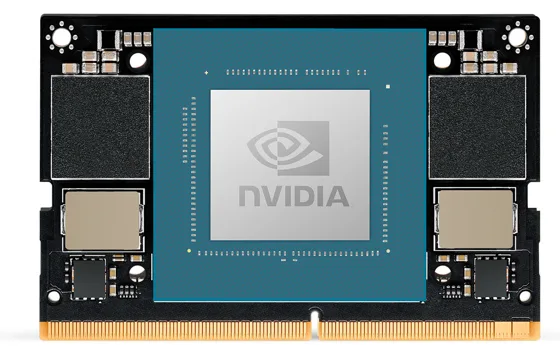
NVIDIA Jetson Orin Nano 4GB module
Class: Embedded GPU module (NVIDIA Jetson: Arm CPU + GPU + shared memory on one module) (class assigned by the author; figures below are the manufacturer’s)
Smallest Jetson Orin module: SO-DIMM form factor, Arm CPU, Ampere GPU and shared LPDDR5 memory on one module. Needs a carrier board.
Typical applications (author’s classification, not a vendor claim): Indoor mobile robot (AMR/AGV); UAV / drone; Manipulator / vision-guided picking
- AI throughput
- 34 TOPS (sparse INT8) “AI Performance” row of the module table (the second table on the page labels this figure sparse INT8 TOPS); sparse figures assume structured-sparse networks and are not the same as dense throughput · manufacturer page, read 2026-11-06
- CPU
- 6-core Arm Cortex-A78AE v8.2 64-bit CPU; 1.5MB L2 + 4MB L3; max 1.7GHz CPU and CPU max frequency rows of the module table · manufacturer page, read 2026-11-06
- GPU
- 512-core NVIDIA Ampere architecture GPU with 16 Tensor Cores; max 1020MHz GPU and GPU max frequency rows of the module table · manufacturer page, read 2026-11-06
- Memory
- 4GB 64-bit LPDDR5; 51 GB/s Memory row of the module table (capacity, bus width, type, bandwidth) · manufacturer page, read 2026-11-06
- Power
- 7W-10W-25W Power row of the module table: the selectable power modes in watts as printed on the page; the filter uses the lowest listed mode · manufacturer page, read 2026-11-06
- Interfaces
- Cameras: Up to 4 cameras (8 via virtual channels); 8 lanes MIPI CSI-2; D-PHY 2.1 (up to 20Gbps) | PCIe: 1 x4 + 3 x1; (PCIe Gen3, Root Port, & Endpoint) | Networking: 1x GbE CSI camera, PCIe and networking rows of the module table (the page marks the PCIe, USB and networking rows with an asterisk) · manufacturer page, read 2026-11-06
- Size
- 69.6mm x 45mm; 260-pin SO-DIMM connector Mechanical row of the module table · manufacturer page, read 2026-11-06
- Environment
- Not yet verified in this build
- Software support
- Not yet verified in this build
Manufacturer site · Official product page · Specification page
NVIDIA Jetson Orin Nano 8GB module
Class: Embedded GPU module (NVIDIA Jetson: Arm CPU + GPU + shared memory on one module) (class assigned by the author; figures below are the manufacturer’s)
Orin Nano with twice the memory of the smaller module; the same SO-DIMM form factor. The page also lists a Super developer kit with the same headline figure.
Typical applications (author’s classification, not a vendor claim): Indoor mobile robot (AMR/AGV); UAV / drone; Manipulator / vision-guided picking
- AI throughput
- 67 TOPS (sparse INT8) “AI Performance” row of the module table (the second table on the page labels this figure sparse INT8 TOPS); sparse figures assume structured-sparse networks and are not the same as dense throughput · manufacturer page, read 2026-11-06
- CPU
- 6-core Arm Cortex-A78AE v8.2 64-bit CPU; 1.5MB L2 + 4MB L3; max 1.7GHz CPU and CPU max frequency rows of the module table · manufacturer page, read 2026-11-06
- GPU
- 1024-core NVIDIA Ampere architecture GPU with 32 Tensor Cores; max 1020MHz GPU and GPU max frequency rows of the module table · manufacturer page, read 2026-11-06
- Memory
- 8GB 128-bit LPDDR5; 102 GB/s Memory row of the module table (capacity, bus width, type, bandwidth) · manufacturer page, read 2026-11-06
- Power
- 7W-15W-25W Power row of the module table: the selectable power modes in watts as printed on the page; the filter uses the lowest listed mode · manufacturer page, read 2026-11-06
- Interfaces
- Cameras: Up to 4 cameras (8 via virtual channels); 8 lanes MIPI CSI-2; D-PHY 2.1 (up to 20Gbps) | PCIe: 1 x4 + 3 x1; (PCIe Gen3, Root Port, & Endpoint) | Networking: 1x GbE CSI camera, PCIe and networking rows of the module table (the page marks the PCIe, USB and networking rows with an asterisk) · manufacturer page, read 2026-11-06
- Size
- 69.6mm x 45mm; 260-pin SO-DIMM connector Mechanical row of the module table · manufacturer page, read 2026-11-06
- Environment
- Not yet verified in this build
- Software support
- Not yet verified in this build
Manufacturer site · Official product page · Specification page
NVIDIA Jetson Orin NX 8GB module
Class: Embedded GPU module (NVIDIA Jetson: Arm CPU + GPU + shared memory on one module) (class assigned by the author; figures below are the manufacturer’s)
Mid-range Orin module in the same SO-DIMM form factor, adding a deep-learning accelerator and a vision accelerator to the CPU and GPU.
Typical applications (author’s classification, not a vendor claim): Indoor mobile robot (AMR/AGV); UAV / drone; Manipulator / vision-guided picking; Outdoor ground robot
- AI throughput
- 117 TOPS (sparse INT8) “AI Performance” row of the module table (the second table on the page labels this figure sparse INT8 TOPS); sparse figures assume structured-sparse networks and are not the same as dense throughput · manufacturer page, read 2026-11-06
- CPU
- 6-core Arm Cortex-A78AE v8.2 64-bit CPU; 1.5MB L2 + 4MB L3; max 2GHz CPU and CPU max frequency rows of the module table · manufacturer page, read 2026-11-06
- GPU
- 1024-core NVIDIA Ampere architecture GPU with 32 Tensor Cores; max 1173MHz GPU and GPU max frequency rows of the module table · manufacturer page, read 2026-11-06
- Memory
- 8GB 128-bit LPDDR5; 102.4GB/s Memory row of the module table (capacity, bus width, type, bandwidth) · manufacturer page, read 2026-11-06
- Power
- 10W-15W-25W-40W Power row of the module table: the selectable power modes in watts as printed on the page; the filter uses the lowest listed mode · manufacturer page, read 2026-11-06
- Interfaces
- Cameras: Up to 4 cameras (8 via virtual channels); 8 lanes MIPI CSI-2; D-PHY 2.1 (up to 20Gbps) | PCIe: 1 x4 + 3 x1; (PCIe Gen4, Root Port, & Endpoint) | Networking: 1x GbE CSI camera, PCIe and networking rows of the module table (the page marks the PCIe, USB and networking rows with an asterisk) · manufacturer page, read 2026-11-06
- Size
- 69.6mm x 45mm; 260-pin SO-DIMM connector Mechanical row of the module table · manufacturer page, read 2026-11-06
- Environment
- Not yet verified in this build
- Software support
- Not yet verified in this build
Manufacturer site · Official product page · Specification page
NVIDIA Jetson Orin NX 16GB module
Class: Embedded GPU module (NVIDIA Jetson: Arm CPU + GPU + shared memory on one module) (class assigned by the author; figures below are the manufacturer’s)
The larger-memory Orin NX with more CPU cores than the smaller model, for robots that run several perception networks beside SLAM.
Typical applications (author’s classification, not a vendor claim): Indoor mobile robot (AMR/AGV); Outdoor ground robot; UAV / drone; Manipulator / vision-guided picking
- AI throughput
- 157 TOPS (sparse INT8) “AI Performance” row of the module table (the second table on the page labels this figure sparse INT8 TOPS); sparse figures assume structured-sparse networks and are not the same as dense throughput · manufacturer page, read 2026-11-06
- CPU
- 8-core Arm Cortex-A78AE v8.2 64-bit CPU; 2MB L2 + 4MB L3; max 2GHz CPU and CPU max frequency rows of the module table · manufacturer page, read 2026-11-06
- GPU
- 1024-core NVIDIA Ampere architecture GPU with 32 Tensor Cores; max 1173MHz GPU and GPU max frequency rows of the module table · manufacturer page, read 2026-11-06
- Memory
- 16GB 128-bit LPDDR5; 102.4GB/s Memory row of the module table (capacity, bus width, type, bandwidth) · manufacturer page, read 2026-11-06
- Power
- 10W-15W-25W-40W Power row of the module table: the selectable power modes in watts as printed on the page; the filter uses the lowest listed mode · manufacturer page, read 2026-11-06
- Interfaces
- Cameras: Up to 4 cameras (8 via virtual channels); 8 lanes MIPI CSI-2; D-PHY 2.1 (up to 20Gbps) | PCIe: 1 x4 + 3 x1; (PCIe Gen4, Root Port, & Endpoint) | Networking: 1x GbE CSI camera, PCIe and networking rows of the module table (the page marks the PCIe, USB and networking rows with an asterisk) · manufacturer page, read 2026-11-06
- Size
- 69.6mm x 45mm; 260-pin SO-DIMM connector Mechanical row of the module table · manufacturer page, read 2026-11-06
- Environment
- Not yet verified in this build
- Software support
- Not yet verified in this build
Manufacturer site · Official product page · Specification page
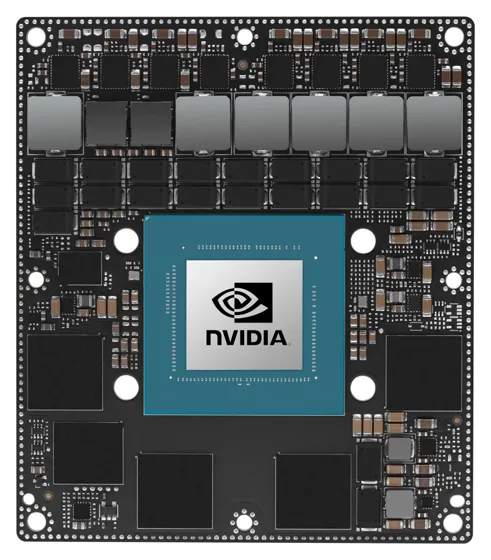
NVIDIA Jetson AGX Orin 32GB module
Class: Embedded GPU module (NVIDIA Jetson: Arm CPU + GPU + shared memory on one module) (class assigned by the author; figures below are the manufacturer’s)
Larger Orin module with a wider memory interface and room for several cameras or LiDARs plus multiple networks.
Typical applications (author’s classification, not a vendor claim): Outdoor ground robot; Indoor mobile robot (AMR/AGV); Humanoid or legged robot; Manipulator / vision-guided picking
- AI throughput
- 200 (the first table on the page states 241 for this module) TOPS (sparse INT8) the page’s two tables disagree for this module: the first table's “AI Performance” row says 241 TOPS and the second table's “Overall AI Performance” row says 200 sparse INT8 TOPS; the lower figure is shown and used for filtering · manufacturer page, read 2026-11-06
- CPU
- 8-core Arm Cortex-A78AE v8.2 64-bit CPU; 2MB L2 + 4MB L3; max 2.2GHz CPU and CPU max frequency rows of the module table · manufacturer page, read 2026-11-06
- GPU
- 1792-core NVIDIA Ampere c GPU with 56 Tensor Cores; max 1.3GHz GPU and GPU max frequency rows of the module table · manufacturer page, read 2026-11-06
- Memory
- 32GB 256-bit LPDDR5; 204.8GB/s Memory row of the module table (capacity, bus width, type, bandwidth) · manufacturer page, read 2026-11-06
- Power
- 15W-60W Power row of the module table: the selectable power modes in watts as printed on the page; the filter uses the lowest listed mode · manufacturer page, read 2026-11-06
- Interfaces
- Cameras: Up to 6 cameras (16 via virtual channels); 16 lanes MIPI CSI-2; D-PHY 2.1 (up to 40Gbps) | C-PHY 2.0 (up to 164Gbps) | PCIe: Up to 2 x8 + 1 x4 + 2 x1; (PCIe Gen4, Root Port, & Endpoint) | Networking: 1x GbE; 1x 10GbE CSI camera, PCIe and networking rows of the module table (the page marks the PCIe, USB and networking rows with an asterisk) · manufacturer page, read 2026-11-06
- Size
- 100mm x 87mm; 699-pin Molex Mirror Mezz Connector; Integrated Thermal Transfer Plate Mechanical row of the module table · manufacturer page, read 2026-11-06
- Environment
- -25 to 80 °C operating temperature at the thermal transfer plate (TTP) surface, Commercial column of the page’s environmental table (the commercial grade lists a 5-year operating lifetime) · manufacturer page, read 2026-11-06
- Software support
- Not yet verified in this build
Manufacturer site · Official product page · Specification page
NVIDIA Jetson AGX Orin 64GB module
Class: Embedded GPU module (NVIDIA Jetson: Arm CPU + GPU + shared memory on one module) (class assigned by the author; figures below are the manufacturer’s)
Top Orin module (commercial grade): the most CPU cores and memory in the Orin line, used where one computer carries perception, mapping and planning.
Typical applications (author’s classification, not a vendor claim): Outdoor ground robot; Humanoid or legged robot; Manipulator / vision-guided picking; Fleet or edge server (many sensors, several networks)
- AI throughput
- 275 TOPS (sparse INT8) “AI Performance” row of the module table (the second table on the page labels this figure sparse INT8 TOPS); sparse figures assume structured-sparse networks and are not the same as dense throughput · manufacturer page, read 2026-11-06
- CPU
- 12-core Arm Cortex-A78AE v8.2 64-bit CPU; 3MB L2 + 6MB L3; max 2.2GHz CPU and CPU max frequency rows of the module table · manufacturer page, read 2026-11-06
- GPU
- 2048-core NVIDIA Ampere architecture GPU with 64 Tensor Cores; max 1.3GHz GPU and GPU max frequency rows of the module table · manufacturer page, read 2026-11-06
- Memory
- 64GB 256-bit LPDDR5; 204.8GB/s Memory row of the module table (capacity, bus width, type, bandwidth) · manufacturer page, read 2026-11-06
- Power
- 15W-60W Power row of the module table: the selectable power modes in watts as printed on the page; the filter uses the lowest listed mode · manufacturer page, read 2026-11-06
- Interfaces
- Cameras: Up to 6 cameras (16 via virtual channels); 16 lanes MIPI CSI-2; D-PHY 2.1 (up to 40Gbps) | C-PHY 2.0 (up to 164Gbps) | PCIe: Up to 2 x8 + 1 x4 + 2 x1; (PCIe Gen4, Root Port, & Endpoint) | Networking: 1x GbE; 1x 10GbE CSI camera, PCIe and networking rows of the module table (the page marks the PCIe, USB and networking rows with an asterisk) · manufacturer page, read 2026-11-06
- Size
- 100mm x 87mm; 699-pin Molex Mirror Mezz Connector; Integrated Thermal Transfer Plate Mechanical row of the module table · manufacturer page, read 2026-11-06
- Environment
- -25 to 80 °C operating temperature at the thermal transfer plate (TTP) surface, Commercial column of the page’s environmental table (the commercial grade lists a 5-year operating lifetime) · manufacturer page, read 2026-11-06
- Software support
- Not yet verified in this build
Manufacturer site · Official product page · Specification page
NVIDIA Jetson AGX Orin Industrial module
Class: Embedded GPU module (NVIDIA Jetson: Arm CPU + GPU + shared memory on one module) (class assigned by the author; figures below are the manufacturer’s)
Industrial-grade AGX Orin with ECC memory and an extended temperature and shock/vibration rating; the page lists a longer operating lifetime than the commercial grade.
Typical applications (author’s classification, not a vendor claim): Outdoor ground robot; Fleet or edge server (many sensors, several networks)
- AI throughput
- 248 TOPS (sparse INT8) “AI Performance” row of the module table (the second table on the page labels this figure sparse INT8 TOPS); sparse figures assume structured-sparse networks and are not the same as dense throughput · manufacturer page, read 2026-11-06
- CPU
- 12-core Arm Cortex-A78AE v8.2 64-bit CPU; 3MB L2 + 6MB L3; max 2.0GHz CPU and CPU max frequency rows of the module table · manufacturer page, read 2026-11-06
- GPU
- 2048-core NVIDIA Ampere architecture GPU with 64 Tensor Cores; max 1.2GHz GPU and GPU max frequency rows of the module table · manufacturer page, read 2026-11-06
- Memory
- 64GB 256-bit LPDDR5 (+ ECC); 204.8GB/s Memory row of the module table (capacity, bus width, type, bandwidth) · manufacturer page, read 2026-11-06
- Power
- 15W-75W Power row of the module table: the selectable power modes in watts as printed on the page; the filter uses the lowest listed mode · manufacturer page, read 2026-11-06
- Interfaces
- Cameras: Up to 6 cameras (16 via virtual channels); 16 lanes MIPI CSI-2; D-PHY 2.1 (up to 40Gbps) | C-PHY 2.0 (up to 164Gbps) | PCIe: Up to 2 x8 + 1 x4 + 2 x1; (PCIe Gen4, Root Port, & Endpoint) | Networking: 1x GbE; 1x 10GbE CSI camera, PCIe and networking rows of the module table (the page marks the PCIe, USB and networking rows with an asterisk) · manufacturer page, read 2026-11-06
- Size
- 100mm x 87mm; 699-pin Molex Mirror Mezz Connector; Integrated Thermal Transfer Plate Mechanical row of the module table · manufacturer page, read 2026-11-06
- Environment
- -40 to 85 °C operating temperature at the thermal transfer plate (TTP) surface, Industrial column of the page’s environmental table; the page also lists inline ECC, a 10-year operating lifetime, operational shock 50 G (11 ms) and operational vibration 5 G · manufacturer page, read 2026-11-06
- Software support
- Not yet verified in this build
Manufacturer site · Official product page · Specification page
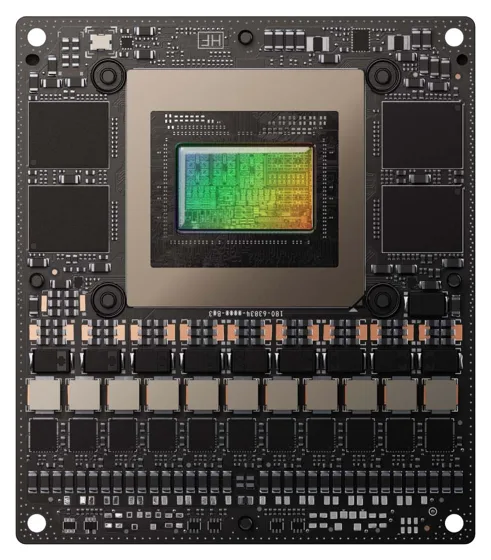
NVIDIA Jetson T4000 module (Jetson Thor family)
Class: Embedded GPU module (NVIDIA Jetson: Arm CPU + GPU + shared memory on one module) (class assigned by the author; figures below are the manufacturer’s)
Blackwell-generation Jetson module in the lower of the two Thor module tiers, with an Arm Neoverse CPU and unified memory; the page is titled “Advanced AI for Physical Robotics”.
Typical applications (author’s classification, not a vendor claim): Humanoid or legged robot; Outdoor ground robot; Manipulator / vision-guided picking
- AI throughput
- 1200 TFLOPS (FP4, sparse) “AI Performance” row of the Jetson Thor module table; FP4 sparse TFLOPS is a different metric from the Orin sparse INT8 TOPS and the two are not comparable by number · manufacturer page, read 2026-11-06
- CPU
- 12-core Arm Neoverse-V3AE 64-bit CPU; 1 MB L2 cache per core; 16 MB shared system L3 cache; max 2.6GHz CPU and CPU max frequency rows of the module table · manufacturer page, read 2026-11-06
- GPU
- 1536-core NVIDIA Blackwell architecture GPU with fifth-gen Tensor Cores; Multi-Instance GPU (MIG) with six TPCs; max 1.53GHz GPU and GPU max frequency rows of the module table · manufacturer page, read 2026-11-06
- Memory
- 64 GB 256-bit LPDDR5X; 273 GB/s Memory row of the module table (capacity, bus width, type, bandwidth) · manufacturer page, read 2026-11-06
- Power
- 40W–70W Power row of the module table: the selectable power modes in watts as printed on the page; the filter uses the lowest listed mode · manufacturer page, read 2026-11-06
- Interfaces
- Cameras: Up to 20 cameras via HSB; Up to 6 cameras through 16x lanes MIPI CSI-2; Up to 32 cameras using Virtual Channels; C-PHY 2.1 (10.25 Gbps); D-PHY 2.1 (40 Gbps) | PCIe: Up to Gen5 (x8 lanes); Root port only—C1 (x1) and C3 (x2); Root Point or Endpoint—C2 (x1), C4 (x8), and C5 (x4) | Networking: 3x 25GbE CSI camera, PCIe and networking rows of the module table (the page marks the PCIe, USB and networking rows with an asterisk) · manufacturer page, read 2026-11-06
- Size
- 100 mm x 87 mm; 699-pin B2B connector; Integrated Thermal Transfer Plate (TTP) with heatpipe Mechanical row of the module table · manufacturer page, read 2026-11-06
- Environment
- Not yet verified in this build
- Software support
- Not yet verified in this build
Manufacturer site · Official product page · Specification page
NVIDIA Jetson T5000 module (Jetson Thor family)
Class: Embedded GPU module (NVIDIA Jetson: Arm CPU + GPU + shared memory on one module) (class assigned by the author; figures below are the manufacturer’s)
Top Jetson Thor module, with more CPU cores and memory than the T4000; NVIDIA also sells it in a developer kit with the same headline AI figure.
Typical applications (author’s classification, not a vendor claim): Humanoid or legged robot; Fleet or edge server (many sensors, several networks); Manipulator / vision-guided picking
- AI throughput
- 2070 TFLOPS (FP4, sparse) “AI Performance” row of the Jetson Thor module table; FP4 sparse TFLOPS is a different metric from the Orin sparse INT8 TOPS and the two are not comparable by number · manufacturer page, read 2026-11-06
- CPU
- 14-core Arm Neoverse-V3AE 64-bit CPU; 1 MB L2 cache per core; 16 MB shared system L3 cache; max 2.6GHz CPU and CPU max frequency rows of the module table · manufacturer page, read 2026-11-06
- GPU
- 2560-core NVIDIA Blackwell architecture GPU with fifth-gen Tensor Cores; Multi-Instance GPU (MIG) with 10 TPCs; max 1.57GHz GPU and GPU max frequency rows of the module table · manufacturer page, read 2026-11-06
- Memory
- 128 GB 256-bit LPDDR5X; 273 GB/s Memory row of the module table (capacity, bus width, type, bandwidth) · manufacturer page, read 2026-11-06
- Power
- 40W–130W Power row of the module table: the selectable power modes in watts as printed on the page; the filter uses the lowest listed mode · manufacturer page, read 2026-11-06
- Interfaces
- Cameras: Up to 20 cameras via HSB; Up to 6 cameras through 16x lanes MIPI CSI-2; Up to 32 cameras using Virtual Channels; C-PHY 2.1 (10.25 Gbps); D-PHY 2.1 (40 Gbps) | PCIe: Up to Gen5 (x8 lanes); Root port only—C1 (x1) and C3 (x2); Root Point or Endpoint—C2 (x1), C4 (x8), and C5 (x4) | Networking: 4x 25GbE CSI camera, PCIe and networking rows of the module table (the page marks the PCIe, USB and networking rows with an asterisk) · manufacturer page, read 2026-11-06
- Size
- 100 mm x 87 mm; 699-pin B2B connector; Integrated Thermal Transfer Plate (TTP) with heatpipe Mechanical row of the module table · manufacturer page, read 2026-11-06
- Environment
- Not yet verified in this build
- Software support
- Not yet verified in this build
Manufacturer site · Official product page · Specification page
ASUS NUC 14 Pro (Intel Core Ultra / Core 3)
Class: x86 mini PC (NUC-class) (class assigned by the author; figures below are the manufacturer’s)
Small-form-factor x86 PC from the former Intel NUC line, now made by ASUS; ships with or without memory and storage, in several CPU options. Typical choice when the robot has room and power for a conventional PC and wants mainstream software support.
Typical applications (author’s classification, not a vendor claim): Indoor mobile robot (AMR/AGV); Manipulator / vision-guided picking; Fleet or edge server (many sensors, several networks)
- AI throughput
- 11 TOPS (INT8, NPU only) peak figure of the Intel AI Boost NPU in the Core Ultra 7 155H, one of the CPU options; Intel’s page gives NPU TOPS only, and the CPU and integrated GPU also run neural networks at figures not included here; the Core 3 option has no such NPU figure on the page · manufacturer page, read 2026-11-06
- CPU
- Intel Core 3 100U (cTDP 25 W); Core Ultra 5 125H, Core Ultra 5 135H with vPro, Core Ultra 7 155H, Core Ultra 7 165H with vPro (cTDP 40 W) CPU row of the ASUS technical-specification page; Intel’s specification page for the Core Ultra 7 155H lists 16 cores (6 performance, 8 efficient, 2 low-power efficient), 4.8 GHz maximum turbo and 28 W base power · manufacturer page, read 2026-11-06
- GPU
- Intel Arc Graphics (Core Ultra options; needs two SO-DIMMs); Intel Graphics (Core 3) Graphics row of the ASUS specification page; this is an integrated GPU: it is not CUDA hardware · manufacturer page, read 2026-11-06
- Memory
- DDR5-5600 SO-DIMM, two slots; the page prints “Max Capacity: 48GB DDR5-5600 SO-DIMM x 2” Memory row of the ASUS specification page; the Intel page for the Core Ultra 7 155H lists a 96 GB maximum memory size, consistent with two 48 GB modules; memory is a separate purchase on some SKUs · manufacturer page, read 2026-11-06
- Power
- CPU cTDP 25 W (Core 3) or 40 W (Core Ultra); 19 V DC adapter, 90 W or 120 W depending on model CPU rows and Power Adapter row of the ASUS specification page; the adapter rating is the supply rating, not the measured consumption; the filter uses the lowest cTDP · manufacturer page, read 2026-11-06
- Interfaces
- Intel I226 2.5 GbE LAN; Thunderbolt 4 Type-C, USB 3.2 Gen 2 Type-A and HDMI 2.1 ports; M.2 NVMe PCIe 4.0 storage slots LAN, I/O-port and Storage rows of the ASUS specification page; the exact port set differs between the models on that page · manufacturer page, read 2026-11-06
- Size
- 117 × 112 × 37 mm or 117 × 112 × 54 mm depending on model; 0.47 to 0.60 kg depending on model Dimensions and Weight rows of the ASUS specification page (a further column on that page is listed at 107 × 102 × 29 mm) · manufacturer page, read 2026-11-06
- Environment
- Not yet verified in this build
- Software support
- Windows 11, Chrome OS Flex, Red Hat Enterprise Linux, Ubuntu 24.04 LTS supported operating systems on the ASUS specification page; ROS 2 support follows from the Linux distribution, which this page does not state · manufacturer page, read 2026-11-06
Manufacturer site · Official product page · Specification page
Hailo Hailo-8 M.2 AI acceleration module
Class: AI accelerator add-in (M.2 or USB card; needs a host) (class assigned by the author; figures below are the manufacturer’s)
Add-in neural-network accelerator on an M.2 card: it runs inference only, so the robot still needs a host computer (x86 or Arm) with a free M.2 or PCIe slot. A way to add detection to a host that has a CPU but no GPU.
Typical applications (author’s classification, not a vendor claim): Indoor mobile robot (AMR/AGV); UAV / drone; Manipulator / vision-guided picking; Fleet or edge server (many sensors, several networks)
- AI throughput
- 26 TOPS (up to) the page describes the Hailo-8 AI processor as having “up to 26 TOPS”; the page does not state the numeric precision · manufacturer page, read 2026-11-06
- CPU
- Not yet verified in this build
- GPU
- Not yet verified in this build
- Memory
- Not yet verified in this build
- Power
- Not yet verified in this build
- Interfaces
- PCIe Gen 3.0, 4 lanes (up to 32 Gbps) or 2 lanes (up to 16 Gbps), depending on variant Interface row of the page’s variant table · manufacturer page, read 2026-11-06
- Size
- 22 × 42 mm with breakable extensions to 22 × 60 mm and 22 × 80 mm; one listed variant is 22 × 30 mm Dimensions row of the page’s variant table · manufacturer page, read 2026-11-06
- Environment
- Not yet verified in this build
- Software support
- TensorFlow, TensorFlow Lite, ONNX, Keras, PyTorch; Linux and Windows Supported Frameworks and Supported OS rows of the page · manufacturer page, read 2026-11-06
Manufacturer site · Official product page · Specification page
Radxa ROCK 5B
Class: Arm single-board computer (class assigned by the author; figures below are the manufacturer’s)
Arm single-board computer with a built-in neural-network accelerator, a lower-cost step below the Jetson modules. CPU-only workloads and light inference fit; CUDA software does not run on it.
Typical applications (author’s classification, not a vendor claim): Indoor mobile robot (AMR/AGV); UAV / drone
- AI throughput
- 6 TOPS (up to) the page states the built-in NPU supports INT4, INT8, INT16 and FP16 hybrid operation with computing power “up to 6 TOPS” · manufacturer page, read 2026-11-06
- CPU
- Not yet verified in this build
- GPU
- Not yet verified in this build
- Memory
- Not yet verified in this build
- Power
- Not yet verified in this build
- Interfaces
- 2.5G Ethernet (PoE needs an additional HAT), HDMI, DisplayPort via Type-C, MIPI CSI and MIPI DSI features text of the product page; the page’s full technical-specification table was not read in this build · manufacturer page, read 2026-11-06
- Size
- Not yet verified in this build
- Environment
- Not yet verified in this build
- Software support
- Not yet verified in this build
Manufacturer site · Official product page · Specification page
OnLogic Industrial computer families
Class: Industrial or rugged PC (class from the vendor’s general positioning; not verified against its documentation in this build)
Fanless and rugged x86 industrial computers for edge and automation, configurable with Intel Core, Xeon or AMD Ryzen processors and PCIe expansion according to the vendor’s category page. Model-level specifications were not read in this build.
Typical applications (author’s classification, not a vendor claim): Outdoor ground robot; Indoor mobile robot (AMR/AGV); Fleet or edge server (many sensors, several networks)
- AI throughput
- Not yet verified in this build
- CPU
- Not yet verified in this build
- GPU
- Not yet verified in this build
- Memory
- Not yet verified in this build
- Power
- Not yet verified in this build
- Interfaces
- Not yet verified in this build
- Size
- Not yet verified in this build
- Environment
- Not yet verified in this build
- Software support
- Not yet verified in this build
Manufacturer site · Official product page · Datasheet: link not verified
NEXCOM Robot controller and industrial PC lines
Class: Industrial or rugged PC (class from the vendor’s general positioning; not verified against its documentation in this build)
Industrial computing vendor whose site lists robot control and industrial IoT products. Model-level specifications were not read in this build.
Typical applications (author’s classification, not a vendor claim): Indoor mobile robot (AMR/AGV); Outdoor ground robot; Fleet or edge server (many sensors, several networks)
- AI throughput
- Not yet verified in this build
- CPU
- Not yet verified in this build
- GPU
- Not yet verified in this build
- Memory
- Not yet verified in this build
- Power
- Not yet verified in this build
- Interfaces
- Not yet verified in this build
- Size
- Not yet verified in this build
- Environment
- Not yet verified in this build
- Software support
- Not yet verified in this build
Manufacturer site · Product page: link not verified · Datasheet: link not verified
Cincoze Rugged embedded computers
Class: Industrial or rugged PC (class from the vendor’s general positioning; not verified against its documentation in this build)
Rugged edge-computing vendor for industrial and vehicle use. Model-level specifications were not read in this build.
Typical applications (author’s classification, not a vendor claim): Outdoor ground robot; Fleet or edge server (many sensors, several networks)
- AI throughput
- Not yet verified in this build
- CPU
- Not yet verified in this build
- GPU
- Not yet verified in this build
- Memory
- Not yet verified in this build
- Power
- Not yet verified in this build
- Interfaces
- Not yet verified in this build
- Size
- Not yet verified in this build
- Environment
- Not yet verified in this build
- Software support
- Not yet verified in this build
Manufacturer site · Product page: link not verified · Datasheet: link not verified
Neousys Rugged embedded and GPU computers
Class: Industrial or rugged PC (class from the vendor’s general positioning; not verified against its documentation in this build)
Vendor of rugged embedded computers, including models built around NVIDIA Jetson modules and models with GPU slots, from general knowledge of the company; its site could not be read in this build.
Typical applications (author’s classification, not a vendor claim): Outdoor ground robot; Indoor mobile robot (AMR/AGV); Fleet or edge server (many sensors, several networks)
- AI throughput
- Not yet verified in this build
- CPU
- Not yet verified in this build
- GPU
- Not yet verified in this build
- Memory
- Not yet verified in this build
- Power
- Not yet verified in this build
- Interfaces
- Not yet verified in this build
- Size
- Not yet verified in this build
- Environment
- Not yet verified in this build
- Software support
- Not yet verified in this build
Manufacturer site · Product page: link not verified · Datasheet: link not verified
Advantech Industrial and edge AI computers
Class: Industrial or rugged PC (class from the vendor’s general positioning; not verified against its documentation in this build)
Large industrial-computing vendor with edge and AI computers, from general knowledge of the company; the product pages tried in this build returned errors.
Typical applications (author’s classification, not a vendor claim): Fleet or edge server (many sensors, several networks); Indoor mobile robot (AMR/AGV); Outdoor ground robot
- AI throughput
- Not yet verified in this build
- CPU
- Not yet verified in this build
- GPU
- Not yet verified in this build
- Memory
- Not yet verified in this build
- Power
- Not yet verified in this build
- Interfaces
- Not yet verified in this build
- Size
- Not yet verified in this build
- Environment
- Not yet verified in this build
- Software support
- Not yet verified in this build
Manufacturer site · Product page: link not verified · Datasheet: link not verified
Vecow Embedded and in-vehicle computers
Class: Industrial or rugged PC (class from the vendor’s general positioning; not verified against its documentation in this build)
Vendor of embedded and in-vehicle computers, from general knowledge of the company; its site could not be read in this build.
Typical applications (author’s classification, not a vendor claim): Outdoor ground robot; Fleet or edge server (many sensors, several networks)
- AI throughput
- Not yet verified in this build
- CPU
- Not yet verified in this build
- GPU
- Not yet verified in this build
- Memory
- Not yet verified in this build
- Power
- Not yet verified in this build
- Interfaces
- Not yet verified in this build
- Size
- Not yet verified in this build
- Environment
- Not yet verified in this build
- Software support
- Not yet verified in this build
Manufacturer site · Product page: link not verified · Datasheet: link not verified
Google Coral Coral Edge TPU accelerators
Class: AI accelerator add-in (M.2 or USB card; needs a host) (class from the vendor’s general positioning; not verified against its documentation in this build)
Edge neural-network accelerators from Google in module and add-in card forms for models compiled for them. The landing page read in this build gave no model-level specifications.
Typical applications (author’s classification, not a vendor claim): Indoor mobile robot (AMR/AGV); UAV / drone
- AI throughput
- Not yet verified in this build
- CPU
- Not yet verified in this build
- GPU
- Not yet verified in this build
- Memory
- Not yet verified in this build
- Power
- Not yet verified in this build
- Interfaces
- Not yet verified in this build
- Size
- Not yet verified in this build
- Environment
- Not yet verified in this build
- Software support
- Not yet verified in this build
Manufacturer site · Product page: link not verified · Datasheet: link not verified
Raspberry Pi Raspberry Pi single-board computers
Class: Arm single-board computer (class from the vendor’s general positioning; not verified against its documentation in this build)
Widely used Arm single-board computers with a large software community; CPU-only for neural networks unless an add-in accelerator is attached. The manufacturer’s site refused automated reading in this build.
Typical applications (author’s classification, not a vendor claim): Indoor mobile robot (AMR/AGV); UAV / drone
- AI throughput
- Not yet verified in this build
- CPU
- Not yet verified in this build
- GPU
- Not yet verified in this build
- Memory
- Not yet verified in this build
- Power
- Not yet verified in this build
- Interfaces
- Not yet verified in this build
- Size
- Not yet verified in this build
- Environment
- Not yet verified in this build
- Software support
- Not yet verified in this build
Manufacturer site · Product page: link not verified · Datasheet: link not verified
Manufacturer comparison table
Grouped by class so that a module, a PC and an add-in accelerator are not compared as if equivalent. The condition under each value says what it applies to. Cells that read “Not yet verified” have no usable manufacturer source in this build.
| Class | Manufacturer | Model | AI throughput | CPU | Memory | Power | Size | Source |
|---|---|---|---|---|---|---|---|---|
| Embedded GPU module (NVIDIA Jetson: Arm CPU + GPU + shared memory on one module) | NVIDIA | Jetson Orin Nano 4GB module | 34 TOPS (sparse INT8) “AI Performance” row of the module table (the second table on the page labels this figure sparse INT8 TOPS); sparse figures assume structured-sparse networks and are not the same as dense throughput · manufacturer page, read 2026-11-06 | 6-core Arm Cortex-A78AE v8.2 64-bit CPU; 1.5MB L2 + 4MB L3; max 1.7GHz CPU and CPU max frequency rows of the module table · manufacturer page, read 2026-11-06 | 4GB 64-bit LPDDR5; 51 GB/s Memory row of the module table (capacity, bus width, type, bandwidth) · manufacturer page, read 2026-11-06 | 7W-10W-25W Power row of the module table: the selectable power modes in watts as printed on the page; the filter uses the lowest listed mode · manufacturer page, read 2026-11-06 | 69.6mm x 45mm; 260-pin SO-DIMM connector Mechanical row of the module table · manufacturer page, read 2026-11-06 | spec page |
| Embedded GPU module (NVIDIA Jetson: Arm CPU + GPU + shared memory on one module) | NVIDIA | Jetson Orin Nano 8GB module | 67 TOPS (sparse INT8) “AI Performance” row of the module table (the second table on the page labels this figure sparse INT8 TOPS); sparse figures assume structured-sparse networks and are not the same as dense throughput · manufacturer page, read 2026-11-06 | 6-core Arm Cortex-A78AE v8.2 64-bit CPU; 1.5MB L2 + 4MB L3; max 1.7GHz CPU and CPU max frequency rows of the module table · manufacturer page, read 2026-11-06 | 8GB 128-bit LPDDR5; 102 GB/s Memory row of the module table (capacity, bus width, type, bandwidth) · manufacturer page, read 2026-11-06 | 7W-15W-25W Power row of the module table: the selectable power modes in watts as printed on the page; the filter uses the lowest listed mode · manufacturer page, read 2026-11-06 | 69.6mm x 45mm; 260-pin SO-DIMM connector Mechanical row of the module table · manufacturer page, read 2026-11-06 | spec page |
| Embedded GPU module (NVIDIA Jetson: Arm CPU + GPU + shared memory on one module) | NVIDIA | Jetson Orin NX 8GB module | 117 TOPS (sparse INT8) “AI Performance” row of the module table (the second table on the page labels this figure sparse INT8 TOPS); sparse figures assume structured-sparse networks and are not the same as dense throughput · manufacturer page, read 2026-11-06 | 6-core Arm Cortex-A78AE v8.2 64-bit CPU; 1.5MB L2 + 4MB L3; max 2GHz CPU and CPU max frequency rows of the module table · manufacturer page, read 2026-11-06 | 8GB 128-bit LPDDR5; 102.4GB/s Memory row of the module table (capacity, bus width, type, bandwidth) · manufacturer page, read 2026-11-06 | 10W-15W-25W-40W Power row of the module table: the selectable power modes in watts as printed on the page; the filter uses the lowest listed mode · manufacturer page, read 2026-11-06 | 69.6mm x 45mm; 260-pin SO-DIMM connector Mechanical row of the module table · manufacturer page, read 2026-11-06 | spec page |
| Embedded GPU module (NVIDIA Jetson: Arm CPU + GPU + shared memory on one module) | NVIDIA | Jetson Orin NX 16GB module | 157 TOPS (sparse INT8) “AI Performance” row of the module table (the second table on the page labels this figure sparse INT8 TOPS); sparse figures assume structured-sparse networks and are not the same as dense throughput · manufacturer page, read 2026-11-06 | 8-core Arm Cortex-A78AE v8.2 64-bit CPU; 2MB L2 + 4MB L3; max 2GHz CPU and CPU max frequency rows of the module table · manufacturer page, read 2026-11-06 | 16GB 128-bit LPDDR5; 102.4GB/s Memory row of the module table (capacity, bus width, type, bandwidth) · manufacturer page, read 2026-11-06 | 10W-15W-25W-40W Power row of the module table: the selectable power modes in watts as printed on the page; the filter uses the lowest listed mode · manufacturer page, read 2026-11-06 | 69.6mm x 45mm; 260-pin SO-DIMM connector Mechanical row of the module table · manufacturer page, read 2026-11-06 | spec page |
| Embedded GPU module (NVIDIA Jetson: Arm CPU + GPU + shared memory on one module) | NVIDIA | Jetson AGX Orin 32GB module | 200 (the first table on the page states 241 for this module) TOPS (sparse INT8) the page’s two tables disagree for this module: the first table's “AI Performance” row says 241 TOPS and the second table's “Overall AI Performance” row says 200 sparse INT8 TOPS; the lower figure is shown and used for filtering · manufacturer page, read 2026-11-06 | 8-core Arm Cortex-A78AE v8.2 64-bit CPU; 2MB L2 + 4MB L3; max 2.2GHz CPU and CPU max frequency rows of the module table · manufacturer page, read 2026-11-06 | 32GB 256-bit LPDDR5; 204.8GB/s Memory row of the module table (capacity, bus width, type, bandwidth) · manufacturer page, read 2026-11-06 | 15W-60W Power row of the module table: the selectable power modes in watts as printed on the page; the filter uses the lowest listed mode · manufacturer page, read 2026-11-06 | 100mm x 87mm; 699-pin Molex Mirror Mezz Connector; Integrated Thermal Transfer Plate Mechanical row of the module table · manufacturer page, read 2026-11-06 | spec page |
| Embedded GPU module (NVIDIA Jetson: Arm CPU + GPU + shared memory on one module) | NVIDIA | Jetson AGX Orin 64GB module | 275 TOPS (sparse INT8) “AI Performance” row of the module table (the second table on the page labels this figure sparse INT8 TOPS); sparse figures assume structured-sparse networks and are not the same as dense throughput · manufacturer page, read 2026-11-06 | 12-core Arm Cortex-A78AE v8.2 64-bit CPU; 3MB L2 + 6MB L3; max 2.2GHz CPU and CPU max frequency rows of the module table · manufacturer page, read 2026-11-06 | 64GB 256-bit LPDDR5; 204.8GB/s Memory row of the module table (capacity, bus width, type, bandwidth) · manufacturer page, read 2026-11-06 | 15W-60W Power row of the module table: the selectable power modes in watts as printed on the page; the filter uses the lowest listed mode · manufacturer page, read 2026-11-06 | 100mm x 87mm; 699-pin Molex Mirror Mezz Connector; Integrated Thermal Transfer Plate Mechanical row of the module table · manufacturer page, read 2026-11-06 | spec page |
| Embedded GPU module (NVIDIA Jetson: Arm CPU + GPU + shared memory on one module) | NVIDIA | Jetson AGX Orin Industrial module | 248 TOPS (sparse INT8) “AI Performance” row of the module table (the second table on the page labels this figure sparse INT8 TOPS); sparse figures assume structured-sparse networks and are not the same as dense throughput · manufacturer page, read 2026-11-06 | 12-core Arm Cortex-A78AE v8.2 64-bit CPU; 3MB L2 + 6MB L3; max 2.0GHz CPU and CPU max frequency rows of the module table · manufacturer page, read 2026-11-06 | 64GB 256-bit LPDDR5 (+ ECC); 204.8GB/s Memory row of the module table (capacity, bus width, type, bandwidth) · manufacturer page, read 2026-11-06 | 15W-75W Power row of the module table: the selectable power modes in watts as printed on the page; the filter uses the lowest listed mode · manufacturer page, read 2026-11-06 | 100mm x 87mm; 699-pin Molex Mirror Mezz Connector; Integrated Thermal Transfer Plate Mechanical row of the module table · manufacturer page, read 2026-11-06 | spec page |
| Embedded GPU module (NVIDIA Jetson: Arm CPU + GPU + shared memory on one module) | NVIDIA | Jetson T4000 module (Jetson Thor family) | 1200 TFLOPS (FP4, sparse) “AI Performance” row of the Jetson Thor module table; FP4 sparse TFLOPS is a different metric from the Orin sparse INT8 TOPS and the two are not comparable by number · manufacturer page, read 2026-11-06 | 12-core Arm Neoverse-V3AE 64-bit CPU; 1 MB L2 cache per core; 16 MB shared system L3 cache; max 2.6GHz CPU and CPU max frequency rows of the module table · manufacturer page, read 2026-11-06 | 64 GB 256-bit LPDDR5X; 273 GB/s Memory row of the module table (capacity, bus width, type, bandwidth) · manufacturer page, read 2026-11-06 | 40W–70W Power row of the module table: the selectable power modes in watts as printed on the page; the filter uses the lowest listed mode · manufacturer page, read 2026-11-06 | 100 mm x 87 mm; 699-pin B2B connector; Integrated Thermal Transfer Plate (TTP) with heatpipe Mechanical row of the module table · manufacturer page, read 2026-11-06 | spec page |
| Embedded GPU module (NVIDIA Jetson: Arm CPU + GPU + shared memory on one module) | NVIDIA | Jetson T5000 module (Jetson Thor family) | 2070 TFLOPS (FP4, sparse) “AI Performance” row of the Jetson Thor module table; FP4 sparse TFLOPS is a different metric from the Orin sparse INT8 TOPS and the two are not comparable by number · manufacturer page, read 2026-11-06 | 14-core Arm Neoverse-V3AE 64-bit CPU; 1 MB L2 cache per core; 16 MB shared system L3 cache; max 2.6GHz CPU and CPU max frequency rows of the module table · manufacturer page, read 2026-11-06 | 128 GB 256-bit LPDDR5X; 273 GB/s Memory row of the module table (capacity, bus width, type, bandwidth) · manufacturer page, read 2026-11-06 | 40W–130W Power row of the module table: the selectable power modes in watts as printed on the page; the filter uses the lowest listed mode · manufacturer page, read 2026-11-06 | 100 mm x 87 mm; 699-pin B2B connector; Integrated Thermal Transfer Plate (TTP) with heatpipe Mechanical row of the module table · manufacturer page, read 2026-11-06 | spec page |
| x86 mini PC (NUC-class) | ASUS | NUC 14 Pro (Intel Core Ultra / Core 3) | 11 TOPS (INT8, NPU only) peak figure of the Intel AI Boost NPU in the Core Ultra 7 155H, one of the CPU options; Intel’s page gives NPU TOPS only, and the CPU and integrated GPU also run neural networks at figures not included here; the Core 3 option has no such NPU figure on the page · manufacturer page, read 2026-11-06 | Intel Core 3 100U (cTDP 25 W); Core Ultra 5 125H, Core Ultra 5 135H with vPro, Core Ultra 7 155H, Core Ultra 7 165H with vPro (cTDP 40 W) CPU row of the ASUS technical-specification page; Intel’s specification page for the Core Ultra 7 155H lists 16 cores (6 performance, 8 efficient, 2 low-power efficient), 4.8 GHz maximum turbo and 28 W base power · manufacturer page, read 2026-11-06 | DDR5-5600 SO-DIMM, two slots; the page prints “Max Capacity: 48GB DDR5-5600 SO-DIMM x 2” Memory row of the ASUS specification page; the Intel page for the Core Ultra 7 155H lists a 96 GB maximum memory size, consistent with two 48 GB modules; memory is a separate purchase on some SKUs · manufacturer page, read 2026-11-06 | CPU cTDP 25 W (Core 3) or 40 W (Core Ultra); 19 V DC adapter, 90 W or 120 W depending on model CPU rows and Power Adapter row of the ASUS specification page; the adapter rating is the supply rating, not the measured consumption; the filter uses the lowest cTDP · manufacturer page, read 2026-11-06 | 117 × 112 × 37 mm or 117 × 112 × 54 mm depending on model; 0.47 to 0.60 kg depending on model Dimensions and Weight rows of the ASUS specification page (a further column on that page is listed at 107 × 102 × 29 mm) · manufacturer page, read 2026-11-06 | spec page |
| Industrial or rugged PC | OnLogic | Industrial computer families | Not yet verified in this build | Not yet verified in this build | Not yet verified in this build | Not yet verified in this build | Not yet verified in this build | link not verified |
| Industrial or rugged PC | NEXCOM | Robot controller and industrial PC lines | Not yet verified in this build | Not yet verified in this build | Not yet verified in this build | Not yet verified in this build | Not yet verified in this build | link not verified |
| Industrial or rugged PC | Cincoze | Rugged embedded computers | Not yet verified in this build | Not yet verified in this build | Not yet verified in this build | Not yet verified in this build | Not yet verified in this build | link not verified |
| Industrial or rugged PC | Neousys | Rugged embedded and GPU computers | Not yet verified in this build | Not yet verified in this build | Not yet verified in this build | Not yet verified in this build | Not yet verified in this build | link not verified |
| Industrial or rugged PC | Advantech | Industrial and edge AI computers | Not yet verified in this build | Not yet verified in this build | Not yet verified in this build | Not yet verified in this build | Not yet verified in this build | link not verified |
| Industrial or rugged PC | Vecow | Embedded and in-vehicle computers | Not yet verified in this build | Not yet verified in this build | Not yet verified in this build | Not yet verified in this build | Not yet verified in this build | link not verified |
| AI accelerator add-in (M.2 or USB card; needs a host) | Hailo | Hailo-8 M.2 AI acceleration module | 26 TOPS (up to) the page describes the Hailo-8 AI processor as having “up to 26 TOPS”; the page does not state the numeric precision · manufacturer page, read 2026-11-06 | Not yet verified in this build | Not yet verified in this build | Not yet verified in this build | 22 × 42 mm with breakable extensions to 22 × 60 mm and 22 × 80 mm; one listed variant is 22 × 30 mm Dimensions row of the page’s variant table · manufacturer page, read 2026-11-06 | spec page |
| AI accelerator add-in (M.2 or USB card; needs a host) | Google Coral | Coral Edge TPU accelerators | Not yet verified in this build | Not yet verified in this build | Not yet verified in this build | Not yet verified in this build | Not yet verified in this build | link not verified |
| Arm single-board computer | Radxa | ROCK 5B | 6 TOPS (up to) the page states the built-in NPU supports INT4, INT8, INT16 and FP16 hybrid operation with computing power “up to 6 TOPS” · manufacturer page, read 2026-11-06 | Not yet verified in this build | Not yet verified in this build | Not yet verified in this build | Not yet verified in this build | spec page |
| Arm single-board computer | Raspberry Pi | Raspberry Pi single-board computers | Not yet verified in this build | Not yet verified in this build | Not yet verified in this build | Not yet verified in this build | Not yet verified in this build | link not verified |
4. Advantages and disadvantages
- One strong computer vs several modest ones: one avoids network copies; several isolate failures and let you scale, at the price of a link carrying sensor data.
- CPU only vs with GPU: a GPU pays off for data-parallel stages (neural networks, dense point-cloud operations); it adds power, cost and a transfer cost (see the workload-allocation guide).
- Peak performance vs sustained: small enclosures throttle: size for the sustained, thermally limited number.
- Headroom: 30 % idle capacity absorbs bursts and software growth.
5. Requirements and constraints
- Power budget (see the power guide) and the thermal path (heat sink, airflow, enclosure).
- Memory: RAM for buffers, maps and models; on shared-memory SoCs the GPU draws from the same pool.
- Interfaces: enough USB, Ethernet, CAN, GPIO, PCIe and camera inputs for all sensors.
- Software: the ROS 2 distribution, CUDA and driver versions supported on the platform.
- Real-time needs: a separate microcontroller for hard deadlines.
6. Architecture
sensors ─▶ [ onboard computer: CPU cores | GPU | RAM | storage ] ─▶ planning/control ─▶ [ microcontroller ] ─▶ motors
                       ▲ power mode, heat sink, battery budget set the sustained performance
7. Implementation
- List the stages and measure ms per frame on the candidate (or a similar machine), with your real data and settings.
- Compute CPU cores of work and GPU busy fraction (see below and the CPU/GPU Resource Estimator).
- Add the data rates, memory and link fit (see the throughput guide).
- Add the reserve for OS and overhead and a margin; pick the smallest class that meets it at the sustained, thermally limited power mode.
- Test on the real robot at full load for an hour, watching frequency, temperature and dropped messages.
import math
# measured on the target (ms per frame) and the frame rate each stage runs at
cpu_stages = [("filter", 12.0, 10), ("slam", 60.0, 10)]        # one core each
gpu_stages = [("detector", 25.0, 30)]
cpu_load = sum(ms * fps / 1000 for _, ms, fps in cpu_stages)   # cores of work
gpu_busy = sum(ms * fps / 1000 for _, ms, fps in gpu_stages)   # fraction of the GPU
reserve = 0.5                                                  # cores for OS, drivers, ROS 2 overhead (assumption)
plan = 0.7                                                     # plan to use at most 70 % of the cores
cores_needed = math.ceil((cpu_load + reserve) / plan)
print(round(cpu_load, 2), round(gpu_busy, 2), cores_needed)
print(gpu_busy <= 0.8)                                         # keep the GPU below ~80 % busy to avoid queueing
Printed (checked by the site’s tests):
0.72 0.75 2
True
Reading it: a 12 ms filter and a 60 ms SLAM stage at 10 Hz need 0.72 cores of work; the 25 ms detector at 30 Hz keeps the GPU 75 % busy. Planning for 70 % core use and half a core of reserve gives at least 2 cores for this pipeline, and the GPU is below the 80 % guideline, so a single GPU suffices. This says nothing about which product: measured times differ per platform.
Shortlisting from sourced figures
Once you have your own needs, filter the candidates by the headline figures from their datasheets. This example uses three Jetson Orin modules with the values from the catalogue above (sparse INT8 TOPS, memory, lowest listed power mode). Because the headline is a sparse figure and the same page lists the dense INT8 figure as half of it for the GPU and DLA, the example compares a dense need against half the headline, then applies the 70 % planning limit. This is a first screen only: confirm with a benchmark of your own network.
# sourced headline figures: (sparse INT8 TOPS, memory GB, lowest listed power mode W) from NVIDIA's Jetson Orin page, read 2026-11-06
CANDIDATES = {"Orin Nano 8GB": (67, 8, 7), "Orin NX 16GB": (157, 16, 10), "AGX Orin 64GB": (275, 64, 15)}
need = {"dense_tops": 40, "mem_gb": 16, "power_w": 25}         # from your own measurements and power budget
headroom = 0.7                                                 # plan to use at most 70 % of the accelerator
for name, (sparse, mem, pmin) in CANDIDATES.items():
    dense_equiv = sparse / 2                                   # the page lists dense INT8 as half of the sparse figure for the GPU and DLA
    why = []
    if dense_equiv * headroom < need["dense_tops"]: why.append("AI")
    if mem < need["mem_gb"]: why.append("memory")
    if pmin > need["power_w"]: why.append("power")
    print(f"{name}: {'ok' if not why else 'no (' + ', '.join(why) + ')'}  usable AI {dense_equiv * headroom:.1f} TOPS")
Printed (checked by the site’s tests):
Orin Nano 8GB: no (AI, memory)  usable AI 23.4 TOPS
Orin NX 16GB: ok  usable AI 54.9 TOPS
AGX Orin 64GB: ok  usable AI 96.2 TOPS
Reading it: with a measured need of 40 dense TOPS, 16 GB of memory and a 25 W budget, the Orin Nano 8GB fails on AI throughput and memory, while the Orin NX 16GB and the AGX Orin 64GB pass. The remaining difference is headroom, power and cost, which the benchmark and the thermal test decide.
8. Real examples
- Camera-heavy small rover: an embedded GPU module for the detector, a CPU for the rest, a microcontroller for motors.
- Large LiDAR SLAM robot: an x86 industrial PC with enough cores and RAM for the map and a fan-cooled enclosure.
- Simple line-following base: an ARM board plus a microcontroller.
9. Failure scenarios
- Sizing from peak benchmark numbers and ignoring throttling.
- Forgetting that CPU and GPU share memory bandwidth on a shared-memory SoC.
- Choosing a power mode that cannot be sustained on the battery.
- Not leaving headroom for software growth.
10. Troubleshooting
- Measure frequency, temperature and utilisation at full load (see the profiling guide).
- If frequency drops, fix cooling or the power mode before changing code.
- If one stage dominates, move or optimise it (workload allocation guide).
- If memory is the limit, reduce map size or buffering.
11. Validation
- Each shortlisted product has been checked against all ten criteria in the criteria table, with figures taken from its own datasheet.
- At full load for an hour: no thermal throttling, no dropped messages, stable rates.
- Every stage satisfies ms per frame × fps ≤ 700 with margin.
- Power draw at full load matches the power budget.
- The sizing and shortlist examples print the values above (executed by the site tests).
12. Engineering checklist
13. Further references
- Jetson figures: NVIDIA, “Jetson AGX Orin / Orin NX / Orin Nano” module tables, nvidia.com, and “Jetson Thor”, nvidia.com, both read 2026-11-06. On the Orin page the two tables disagree on the AI figure of the AGX Orin 32GB (241 and 200 TOPS); the card shows the lower figure and says so.
- ASUS NUC 14 Pro: technical specifications, and Intel Core Ultra 7 155H: Intel specification page, both read 2026-11-06.
- Accelerators and boards: Hailo-8 M.2 module and Radxa ROCK 5B, read 2026-11-06 (the ROCK 5B’s technical-specification table was not read).
- Industrial PC vendors (OnLogic, NEXCOM, Cincoze, Neousys, Advantech, Vecow), Coral and Raspberry Pi: linked to the manufacturers’ sites only; no model-level specifications were read in this build.
- Not covered by a verified source: the selection-criteria tables and the application guidance are general engineering knowledge written for this page.
- Site tools: CPU/GPU Resource Estimator.
Related on FixTheRobot
- Real-Time Performance and Resource Constraints SLAM · Lesson