UAV Systems Engineering · Module 7
M7-T19: Configuration management
Any flight must be reproducible from a record. Control everything that can change the behaviour, and hash it.
A vehicle’s behaviour depends on firmware, companion software, parameters, calibration files, ML model weights and hardware revisions. Change any one and the vehicle is a different system. Configuration management is the discipline of knowing, for every flight, exactly which combination flew.
Learning objectives
After this lesson, you should be able to:
- List the configuration items that determine a UAV’s behaviour.
- Define baselines, change control and a release procedure with approvals.
- Create and verify a flight manifest with content hashes.
- Detect configuration drift between the approved baseline and the vehicle.
Conceptual explanation
Established Configuration management is standard engineering practice, with formal requirements in aviation and safety standards. The tooling here (git, hashes, manifests) is one practical way to achieve it for a small team.
Configuration items for a UAV, any of which can change behaviour:
- Firmware: autopilot build (version, commit hash, board, build flags).
- Companion software: repositories at commits, container images by digest, OS image and kernel, ROS 2 distribution and package versions, model weights.
- Parameters: the autopilot parameter file and the companion’s configuration files.
- Calibration: camera intrinsics, extrinsics, sensor calibrations, with their date and conditions.
- Hardware: airframe, motors, propellers, battery, sensors, with serial numbers and revisions.
- Documents and procedures: the checklist and the test card used.
A baseline is an approved, identified set of configuration items; changes to it go through change control (request, impact analysis against the traceability matrix, review, approval, regression test, new baseline). A flight manifest records the baseline identifier and the hashes of the actual items on the vehicle at take-off.
Engineering intuition
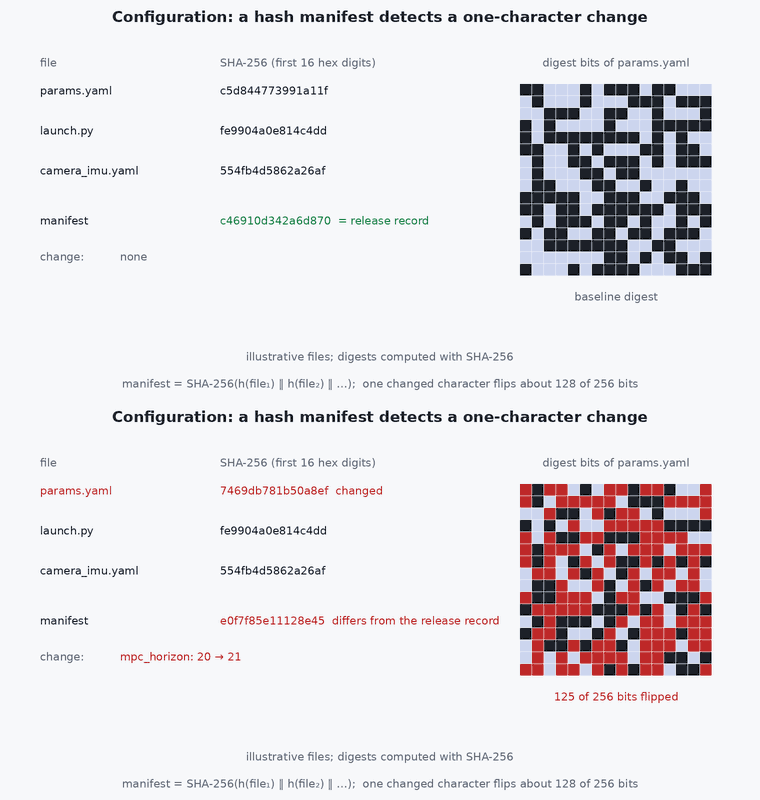
Most unexplained differences between two flights are configuration differences nobody noticed: a parameter changed during a bench test, a calibration file copied from another vehicle, a container image updated overnight. The remedy is boring and effective: compute hashes of everything, store them with the log, and compare automatically before take-off against the approved baseline.
Reproducibility has a second meaning: building the same source twice gives the same binary. Pin dependencies (lock files, image digests), record compiler versions, and avoid “latest”. If you cannot rebuild what flew, you cannot fix it without changing something else.
Mathematical formulation
Integrity checks use cryptographic hashes: a manifest is a map from item name to hash (x) = SHA-256(x). Two configurations are identical iff their manifests are equal, and the manifest itself has a hash (a Merkle-style root over sorted entries) that serves as the configuration identifier in the log:
Drift detection is the set difference between the vehicle’s manifest and the baseline’s: added, removed and changed items. The probability that two different files share a SHA-256 hash is negligible (about by the birthday bound for collisions among files), so a hash mismatch is real and a match is, for practical purposes, identity. Parameters should be compared by value, not only by file hash, so the report can name the parameters that differ.
- (x)
- SHA-256 hash of the content .
- id(config)
- identifier of a configuration derived from its items.
Architecture and data flow
Source repositories (git tags) → CI build (pinned, reproducible; artefact hashes recorded) → release package (firmware, container digests, parameter file, calibration files) with a signed baseline manifest → vehicle installation → pre-flight script computes the vehicle manifest and compares it with the baseline (differences must be zero or approved) → manifest written into the flight log and the test record → archive. Changes: issue → impact analysis → review → merge → new baseline.
Real-world UAV applications
- Pre-flight check that the vehicle matches the approved baseline.
- Tracing a regression to the change that introduced it.
- Reproducing a flight in SITL with the same parameters and software.
- Audit trail for a safety review or incident investigation.
Implementation example
This runs as shown. A manifest builder and a drift checker: it hashes configuration files in a temporary directory, builds the configuration identifier, then modifies one parameter and one calibration file and reports the drift, including the parameter-level difference.
import hashlib, json, tempfile, pathlib

def sha(b): return hashlib.sha256(b).hexdigest()
def build_manifest(root):
    items = {str(p.relative_to(root)): sha(p.read_bytes()) for p in sorted(pathlib.Path(root).rglob('*')) if p.is_file()}
    cid = sha(''.join(n + h for n, h in sorted(items.items())).encode())
    return {'items': items, 'id': cid}
def drift(base, now):
    a, b = base['items'], now['items']
    return {'added': sorted(set(b) - set(a)), 'removed': sorted(set(a) - set(b)), 'changed': sorted(k for k in set(a) & set(b) if a[k] != b[k])}
def parse_params(text): return {k: v for k, v in (l.split(None, 1) for l in text.splitlines() if l and not l.startswith('#'))}

with tempfile.TemporaryDirectory() as d:
    root = pathlib.Path(d); (root / 'params').mkdir(); (root / 'calib').mkdir()
    (root / 'params' / 'px4.params').write_text("# parameters\nEKF2_EV_DELAY 55\nEKF2_HGT_REF 3\nCOM_OF_LOSS_T 1.0\n")
    (root / 'calib' / 'cam0.yaml').write_text("fx: 612.0\nfy: 608.0\n")
    (root / 'VERSION').write_text("fw v1.15.4 abc1234\n")
    base = build_manifest(root); base_params = parse_params((root / 'params' / 'px4.params').read_text())
    assert build_manifest(root)['id'] == base['id']                                  # the identifier is deterministic
    (root / 'params' / 'px4.params').write_text("# parameters\nEKF2_EV_DELAY 80\nEKF2_HGT_REF 3\nCOM_OF_LOSS_T 1.0\n")
    (root / 'calib' / 'cam1.yaml').write_text("fx: 590.0\n")
    now = build_manifest(root); dr = drift(base, now)
    now_params = parse_params((root / 'params' / 'px4.params').read_text())
    pdiff = {k: (base_params[k], now_params[k]) for k in base_params if base_params[k] != now_params.get(k)}
    print("baseline id", base['id'][:12], "-> current id", now['id'][:12]); print("drift:", json.dumps(dr)); print("parameter differences:", pdiff)
assert now['id'] != base['id'] and dr['changed'] == ['params/px4.params'] and dr['added'] == ['calib/cam1.yaml'] and pdiff == {'EKF2_EV_DELAY': ('55', '80')}Common engineering mistakes
Using “latest” for dependencies or images
The build changes without any commit; pin versions and digests.
Editing parameters on the vehicle without recording them
Export and hash before every flight; compare to the baseline.
Copying a calibration from another vehicle
Each unit has its own calibration and serial number.
No hardware records
A propeller or motor swap changes dynamics; log serial numbers.
Baseline changes without regression tests
Tie every change to impact analysis and a rerun of affected tests.
Failure modes
| Failure mode | How it shows up | Likely cause |
|---|---|---|
| Cannot reproduce a flight | Different behaviour in SITL and flight | Parameters, software or calibration differ and were never recorded |
| Regression after an update | A previously working behaviour fails | Unreviewed dependency or image change |
| Mismatched vehicles in a fleet | Vehicles behave differently | Configuration drift between units |
| Wrong calibration loaded | Bad VIO after maintenance | File copied or restored from an old backup |
Debugging approach
- Compare the manifests of a good and a bad flight and list the differences.
- Rebuild from the tag and compare the binary hash with the flown one.
- Check the pre-flight manifest comparison for approved exceptions.
- Diff parameter values, not only files.
Practical exercises
- Define the configuration items and baseline identifier for your vehicle.
- Extend the manifest script to record package versions (pip freeze, apt list) and container digests.
- Write the change-control checklist for a parameter change.
- Reproduce a past flight in SITL from its manifest and compare the logs.
Interview questions
Write an answer in your own words, then reveal the model answer. Nothing is sent anywhere.
Question 1
What is a flight manifest?
Model answer
A record of the hashes and versions of every configuration item on the vehicle at take-off (firmware, software, parameters, calibration, hardware), stored with the flight log so the configuration can be identified and restored.
Question 2
Why compare parameters by value as well as hash?
Model answer
The hash tells you that something differs; the value-level diff tells you what changed, which is what the reviewer needs.
Question 3
What makes a build reproducible?
Model answer
Pinned dependencies and base images, recorded compiler and tool versions, no network fetches of unpinned content, and deterministic build steps, so that the same source gives the same binary.
References and further reading
Primary papers, official documentation and standards. Each claim above that is specific to a tool or version points here.