UAV Systems Engineering · Module 7
M7-T18: Requirements traceability
Traceability answers two questions: why does this exist, and how do we know it works. A matrix that a script can check keeps the answers honest.
A flight test passes. Does it cover the requirement about GNSS-loss behaviour, or some other one? Traceability turns that from a debate into a query. Bidirectional links between needs, requirements, design and tests also make change impact visible: when a requirement changes, you can list the tests to rerun.
Learning objectives
After this lesson, you should be able to:
- Build a bidirectional traceability matrix from needs and hazards to results.
- Compute coverage and identify gaps, orphans and stale results.
- Use traceability to scope the impact of a change.
- Automate the checks in the repository.
Conceptual explanation
Established Traceability is standard systems and safety-engineering practice and is required by many certification and assurance standards. Which links are mandatory depends on the standard that applies; this lesson describes the common core.
Four relations, each in both directions:
- Need or hazard → requirement: every requirement exists for a reason (a stakeholder need, a mission need, a mitigation of an identified hazard).
- Requirement → design element: every requirement is allocated to something that implements it (a module, a parameter, a procedure).
- Requirement → verification: every requirement has at least one test, analysis, inspection or demonstration with a pass criterion.
- Verification → result: every verification has a recorded result tied to a software and hardware version.
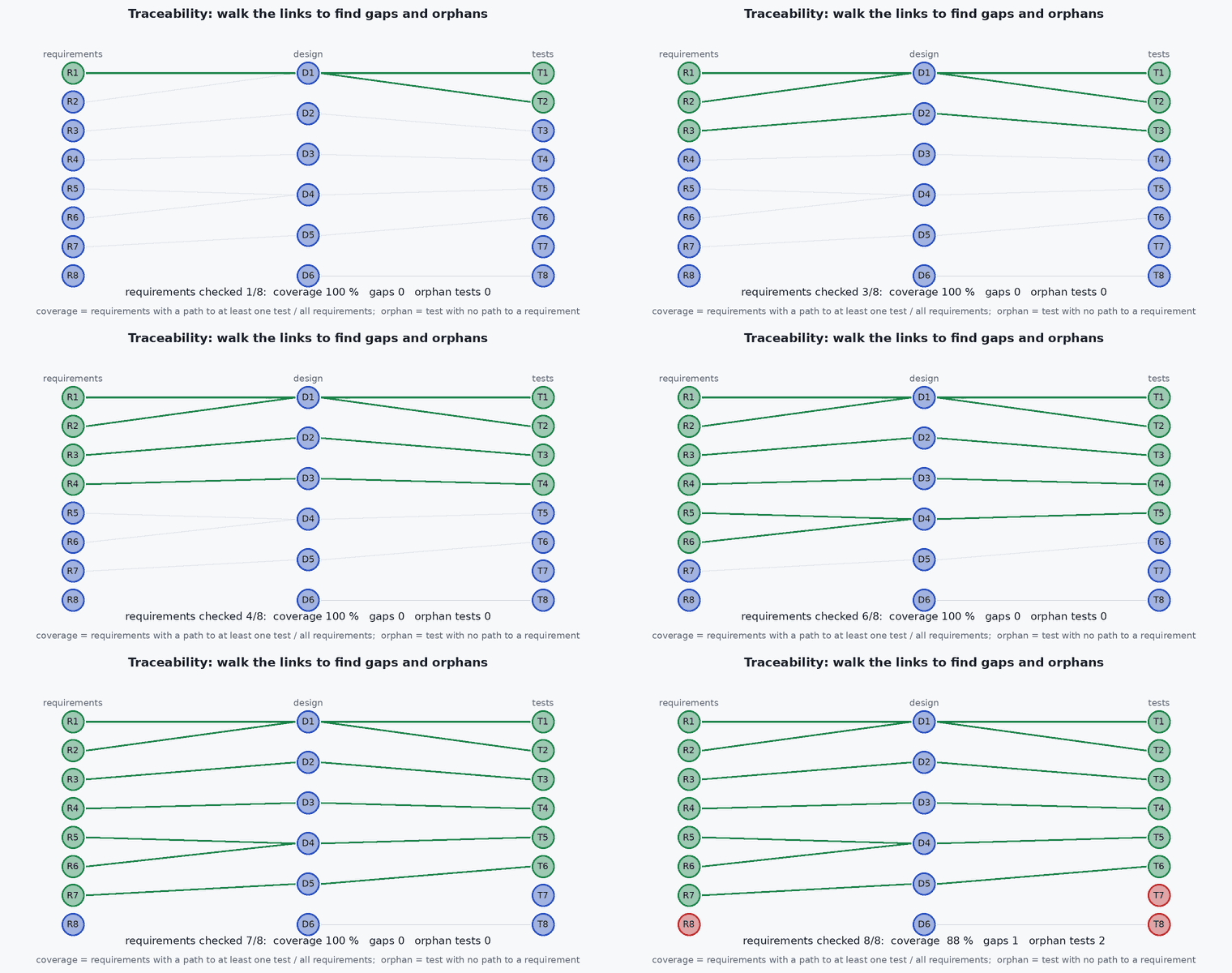
Defects to look for: gaps (a requirement with no design or no verification), orphans (a design element or a test case tracing to no requirement: either a missing requirement or unnecessary work), stale results (the result is for an older version than the one being flown), and weak links (a test whose criterion does not actually demonstrate the requirement).
Engineering intuition
The matrix is useful because it can be queried both ways. Forward: “for this hazard, which requirements mitigate it, and have they all been verified on this release?” Backward: “this test failed; which requirement is at risk, and which hazard does that touch?”. During a design change the forward query is the impact analysis: change the odometry timeout, and the matrix lists the requirements, designs and tests it touches.
The discipline that pays most is writing requirements so that each has a single, testable criterion, with an ID. A requirement like “navigate accurately” cannot trace to a test; “horizontal position error shall not exceed 2.0 m (95th percentile) over a 5-minute GNSS-denied segment” can.
Mathematical formulation
Simple coverage metrics, each between 0 and 1 and required to be 1 (or explained) at a review:
Orphan sets are = { : } and = { : }. Change impact for a changed requirement is the transitive closure of its links: ∪ {requirements sharing the design elements}. For a verification result to count, its version stamp must equal the current baseline (or be covered by an impact analysis that argues the change does not affect it), otherwise the result is stale.
- set of requirements.
- design(r), verif(r)
- design elements and verifications linked to .
- ,
- version of the result and of the current baseline.
Architecture and data flow
Requirements, hazards, design elements and tests live as structured records (YAML, a requirements tool, or issues) with stable IDs and explicit link fields. Test code carries the requirement IDs it verifies (for example in a marker or docstring) and test runs write results with the baseline version. A script in continuous integration builds the matrix, computes coverage, and fails the build on gaps, orphans and stale results beyond an allowed list.
Real-world UAV applications
- Showing which requirements a flight-test campaign verified.
- Impact analysis after changing a failsafe timeout.
- Evidence for a safety review or an airworthiness assessment.
- Planning regression tests after a release.
Implementation example
This runs as shown. A traceability matrix as data and a checker computing coverage, gaps, orphans and stale results, including a change-impact query.
needs = {'H-01': 'loss of GNSS leads to unbounded drift', 'N-02': 'mission completes in GNSS-denied area'}
reqs = {'R-10': dict(text='position error <= 2 m (p95) for 5 min without GNSS', traces_to=['N-02', 'H-01'], design=['vio', 'ekf2-ev'], verif=['T-100', 'T-101']),
        'R-11': dict(text='on VIO loss, land or hold within 2 s', traces_to=['H-01'], design=['failsafe-vio'], verif=['T-110']),
        'R-12': dict(text='odometry latency <= 100 ms (p99)', traces_to=['N-02'], design=['vio', 'timestamps'], verif=[]),                 # gap: no verification
        'R-13': dict(text='log all fusion decisions', traces_to=[], design=['logger'], verif=['T-130'])}                                    # orphan requirement: no need
tests = {'T-100': dict(result='pass', version='v1.4'), 'T-101': dict(result='pass', version='v1.3'), 'T-110': dict(result='fail', version='v1.4'),
         'T-130': dict(result='pass', version='v1.4'), 'T-999': dict(result='pass', version='v1.4')}                                            # T-999 verifies nothing
now = 'v1.4'
traced = {t for r in reqs.values() for t in r['verif']}
gaps = [r for r, v in reqs.items() if not v['verif'] or not v['design']]
orphan_reqs = [r for r, v in reqs.items() if not v['traces_to']]
orphan_tests = [t for t in tests if t not in traced]
stale = [t for t, v in tests.items() if v['version'] != now]
passing = [r for r, v in reqs.items() if v['verif'] and all(tests[t]['result'] == 'pass' and tests[t]['version'] == now for t in v['verif'])]
print(f"coverage: verification {sum(1 for v in reqs.values() if v['verif']) / len(reqs):.0%}, passing on {now}: {len(passing) / len(reqs):.0%}")
print("gaps:", gaps, " orphan requirements:", orphan_reqs, " orphan tests:", orphan_tests, " stale results:", stale)
impact = lambda d: sorted(r for r, v in reqs.items() if d in v['design'])
print("change to 'vio' impacts requirements:", impact('vio'), "-> tests:", sorted({t for r in impact('vio') for t in reqs[r]['verif']}))
assert gaps == ['R-12'] and orphan_reqs == ['R-13'] and orphan_tests == ['T-999'] and stale == ['T-101'] and passing == ['R-13']
assert impact('vio') == ['R-10', 'R-12']Common engineering mistakes
Requirements without IDs or criteria
They cannot be traced or tested; write one measurable statement per ID.
A matrix built once at the review
It must be generated from the live records or it rots.
Counting a test as coverage without checking its criterion
Review that the pass criterion demonstrates the requirement.
Ignoring version stamps on results
A passing result for an old version is not evidence for the new one.
Orphan tests kept “because they are useful”
Either add the missing requirement or remove the test.
Failure modes
| Failure mode | How it shows up | Likely cause |
|---|---|---|
| A hazard with no mitigation test | Discovered at the safety review | Matrix never queried from the hazard side |
| Stale evidence | Release flown on results from older code | No version in results |
| Requirement change not propagated | Tests still verify the old value | No change impact analysis |
| Untraceable requirement | No one knows why it exists | Added without a need or hazard |
Debugging approach
- Run the checker in CI and look at the list of gaps before every review.
- Query from a hazard to see the complete chain.
- Check version stamps of the evidence for each requirement.
- Review a sample of tests to confirm their criteria match the requirement text.
Practical exercises
- Build the matrix for the five GNSS-denied requirements of your capstone and run the checker.
- Add a check that every hazard has at least one requirement and every requirement of a hazard has a passing test.
- Compute the impact of changing the VIO timeout parameter.
- Rewrite two vague requirements as measurable ones with a test.
Interview questions
Write an answer in your own words, then reveal the model answer. Nothing is sent anywhere.
Question 1
What is bidirectional traceability?
Model answer
Links from needs and hazards down to requirements, design, tests and results, and back up again, so you can ask both “what verifies this?” and “why does this exist?”.
Question 2
What are orphans and gaps?
Model answer
A gap is a requirement without design or verification; an orphan is a test, design element or requirement with no upward trace. Both indicate a missing link and must be resolved or justified.
Question 3
How does traceability help with change?
Model answer
The links give the impact set: the design elements and tests that must be re-reviewed and rerun when a requirement or component changes.
References and further reading
Primary papers, official documentation and standards. Each claim above that is specific to a tool or version points here.