UAV Systems Engineering · Module 1
M1-T1: Introduction to UAVs and their classifications
Before choosing sensors or algorithms, choose the class of vehicle: size and category decide what payload, endurance and autonomy are even possible.
Unmanned aircraft range from palm-sized quadrotors to aircraft heavier than a car. The class sets the payload, the compute you can carry, the rules you must follow and the consequences of failure. This lesson gives the vocabulary used in the rest of the track.
Learning objectives
After this lesson, you should be able to:
- Classify a UAV by mass, airframe and operation category.
- Relate class to payload, endurance, onboard compute and failure consequences.
- Explain why regulation is by operation and risk, not only by mass, and where to find the rules that apply.
- Choose a class for a GNSS-denied inspection mission and justify it.
Conceptual explanation
UAVs are classified along several independent axes: mass (micro, small, medium, large), airframe (multirotor, fixed-wing, VTOL; lesson M1-T2), endurance and range, autonomy level (remotely piloted, automated, autonomous) and regulatory category. No single global scheme exists: regulators and militaries each define their own groups, and the numerical limits differ.
| Class (indicative) | Typical mass | Endurance driver | Typical use | Implication |
|---|---|---|---|---|
| Micro / nano | below about 250 | tiny battery, minutes | indoor research, toys | almost no payload or compute; often no GNSS-denied sensors |
| Small multirotor | about 0.25–25 kg | 10–50 min on batteries | inspection, survey, filming | room for camera, IMU, LiDAR, a Jetson-class computer at the upper end |
| Fixed-wing / VTOL | about 1–25 kg and above | tens of minutes to hours | mapping, long range | efficient cruise; poor hover; navigation at speed |
| Large / medium | above 25 kg | hours (fuel or large packs) | cargo, agriculture, defence | certification-like requirements; redundancy expected |
Engineering intuition
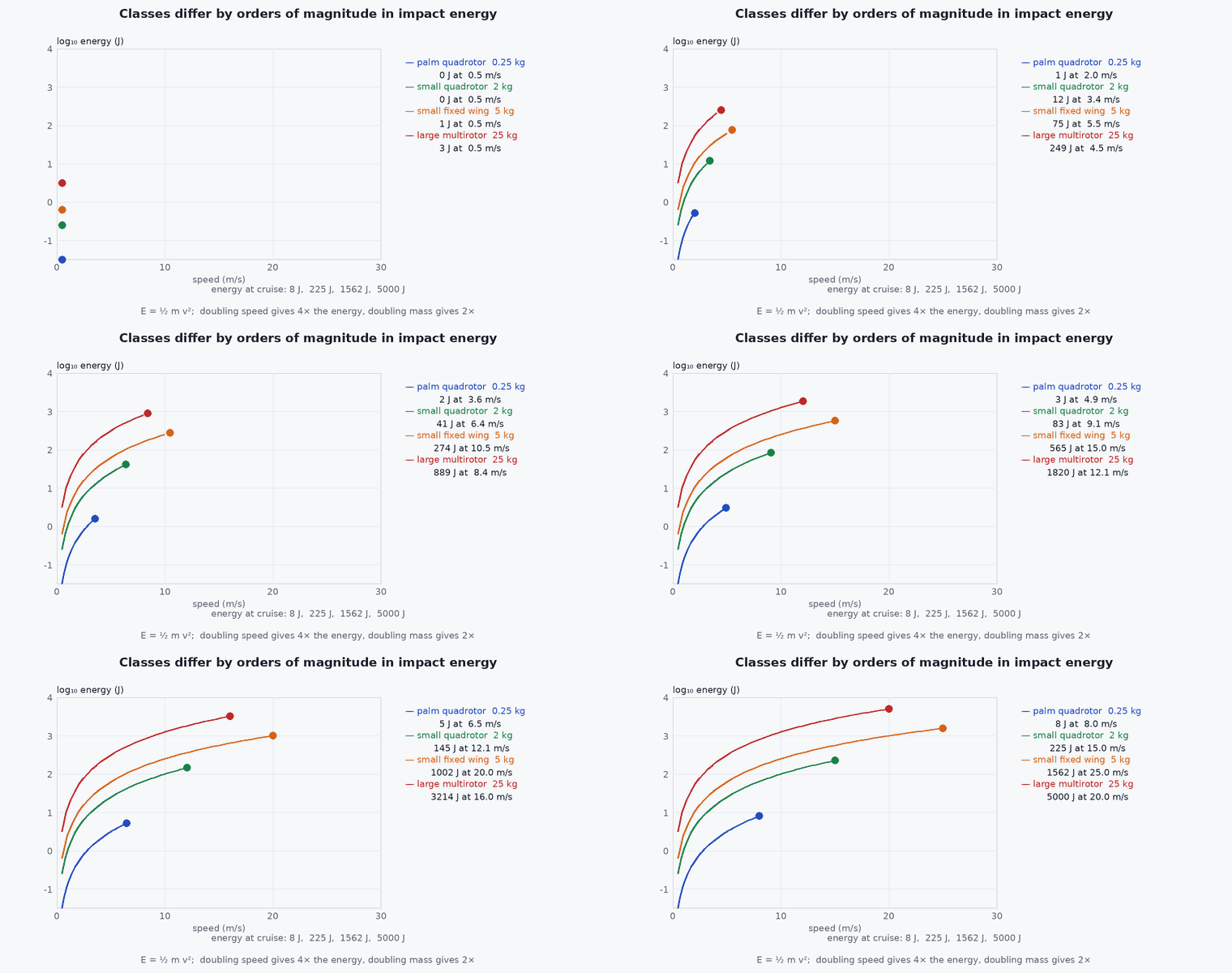
Mass is the master variable because everything scales with it: required thrust, battery size, impact energy and so the harm a failure can do. A 250 drone and a 25 kg drone fail in very different worlds, so the safety case, the redundancy and the acceptable risk differ by orders of magnitude. For autonomy design this has a direct meaning: a heavy vehicle can carry redundant sensors and a powerful computer but must justify safety far more rigorously; a light one must make do with less and is operated under lighter rules.
Regulation follows risk of the operation: where, how close to people, beyond visual line of sight or not. Mass is one input. The numeric limits and category names are jurisdiction-specific and change; always read the current rule for the place you fly.
Mathematical formulation
Kinetic energy at impact is a useful common measure of consequence, and shows why mass and speed both matter:
Wing loading and disc loading characterise airframe class: disc loading (thrust per rotor disc area) for rotorcraft and wing loading (weight per wing area) for aeroplanes; both feed the power estimates of the next lesson. Endurance is the usable energy divided by average power:
- ,
- vehicle mass (kg) and speed (m/s).
- pack energy (Wh).
- mean electrical power (W); see lessons M1-T2 and M1-T7.
Architecture and data flow
For system design, class selection is the first row of the requirements table: mission radius, payload mass, endurance, environment and autonomy level lead to a class; the class then constrains the mass budget, which constrains compute and sensors (lessons M1-T10, M7-T12 and M7-T13), and sets the regulatory process that the verification plan must serve (lessons M8-T3 and M8-T5).
Real-world UAV applications
- Choosing a platform for indoor GNSS-denied inspection (small multirotor).
- Long-range mapping where hover is unnecessary (fixed-wing or VTOL).
- Deciding which regulatory process applies before any flight testing.
- Estimating whether a candidate payload (a LiDAR and a Jetson) fits a vehicle class at all.
Implementation example
This runs as shown: a small helper that screens a mission against vehicle classes by payload and endurance, and computes impact energy. The class boundaries are illustrative, not regulatory.
def impact_energy_j(mass_kg, speed_ms): return 0.5 * mass_kg * speed_ms ** 2

CLASSES = [  # name, max take-off mass (kg), typical max payload fraction, typical endurance (min). Illustrative, not regulatory.
    ("micro", 0.25, 0.10, 10), ("small multirotor", 25.0, 0.25, 35), ("small fixed-wing/VTOL", 25.0, 0.20, 90),
]

def screen(payload_kg, endurance_min):
    ok = []
    for name, mtom, frac, endu in CLASSES:
        if endu >= endurance_min and payload_kg <= mtom * frac: ok.append(name)
    return ok

# A GNSS-denied inspection mission: stereo camera + LiDAR + companion computer + gimbal-free = about 1.2 kg payload, 20 minutes
print("candidates:", screen(1.2, 20))
assert screen(1.2, 20) == ["small multirotor", "small fixed-wing/VTOL"] and screen(1.2, 60) == ["small fixed-wing/VTOL"] and screen(0.02, 5) == ["micro", "small multirotor", "small fixed-wing/VTOL"]
assert impact_energy_j(1, 10) == 50 and abs(impact_energy_j(25, 15) - 2812.5) < 1e-9Common engineering mistakes
Treating mass limits as universal
Thresholds and category names differ by country and change; cite the rule for your jurisdiction.
Choosing the class last
Payload and endurance requirements decide the class, not the other way round.
Equating “small” with “safe”
Risk depends on the operation: near people, over crowds, near airports.
Ignoring the autonomy level in the safety case
Beyond-visual-line-of-sight and autonomous operation raise the evidence expected.
Planning payload without the compute and power it needs
A LiDAR and a computer also need power, cooling and mass for the battery that feeds them.
Failure modes
| Failure mode | How it shows up | Likely cause |
|---|---|---|
| Payload does not fit | Vehicle cannot hold altitude or loses endurance | Payload fraction above what the class supports |
| Wrong regulatory assumption | Flight stopped or insurance void | Category chosen by mass only |
| Insufficient endurance | Mission cannot finish with reserves | Class chosen from datasheet hover time without payload |
| Compute overheats | Throttling mid-mission | Companion computer sized without airflow |
Debugging approach
- Write the mission as numbers (radius, payload, endurance, environment) before comparing classes.
- Check each number against a measured or published figure for a real vehicle in the class.
- Read the operating rules for the jurisdiction and write the operating limits as requirements (lesson M8-T1).
- Recompute endurance with the payload’s power included.
Practical exercises
- Pick a class for a 30-minute tunnel inspection with a 1.5 kg payload and justify the mass and endurance.
- Compute the impact energy of a 2 kg vehicle falling from 30 m (ignoring drag) and compare it with 1 kg at 10 m/s.
- Find the rule for small UAS in your country and list its mass limit and its main operating conditions.
- List three requirements that change when the same vehicle flies beyond visual line of sight.
Interview questions
Write an answer in your own words, then reveal the model answer. Nothing is sent anywhere.
Question 1
Why does vehicle mass drive so many design choices?
Model answer
Thrust, battery size, impact energy and therefore failure consequences all scale with mass, so mass sets the payload, endurance and the rigour of the safety case.
Question 2
Is regulation based on mass alone?
Model answer
No; it is risk-based on the operation (location, distance from people, line of sight, autonomy), with mass as one factor, and details differ by jurisdiction.
Question 3
What does a GNSS-denied inspection mission usually imply for the class?
Model answer
A small multirotor that can hover and fly slowly indoors, with enough payload mass for camera, IMU, LiDAR and a companion computer, and endurance with those loads.
References and further reading
Primary papers, official documentation and standards. Each claim above that is specific to a tool or version points here.
- EASA: operating a drone (open, specific and certified categories)
- FAA: commercial small UAS operations (Part 107)
- EASA: specific category civil drones (operational risk assessment, SORA)
- . . Valavanis, . . Vachtsevanos (eds.), Handbook of Unmanned Aerial Vehicles, Springer, 2015.