UAV Systems Engineering · Module 7
M7-T4: Real-time operating systems
Real-time does not mean fast. It means the worst case is known and bounded, which is what a control loop needs.
A control loop that usually runs in 2 ms and sometimes in 40 ms is a loop that eventually fails. A real-time operating system gives bounded scheduling latency and tools to reason about the worst case. This lesson covers the core ideas and what they mean for PX4’s NuttX and for a Linux companion.
Learning objectives
After this lesson, you should be able to:
- Define hard, firm and soft real-time and give a UAV example of each.
- Run a response-time analysis for fixed-priority tasks.
- Explain priority inversion and priority inheritance.
- Compare how NuttX on a flight controller and Linux on a companion handle real-time requirements.
Conceptual explanation
Established Fixed-priority scheduling theory is from Liu and Layland (1973) and the response-time analysis literature; priority inheritance from Sha, Rajkumar and Lehoczky (1990). Whether a particular OS configuration meets a deadline is a measurement, not a property of its name.
A real-time system must produce results within deadlines. Hard real-time means a missed deadline is a failure (an attitude loop that misses its cycle); firm means a late result is useless but not catastrophic (a late camera frame is dropped); soft means lateness degrades quality (a slightly late video preview).
An RTOS provides preemptive priority scheduling: the highest-priority ready task always runs, a task is preempted as soon as a higher-priority one becomes ready, and the time to do so is bounded. Ingredients that must also be bounded: interrupt latency, the time interrupts are masked, and the time a task can be blocked by lower-priority tasks holding shared resources.
- NuttX (used by PX4 on flight controllers) is a POSIX-like RTOS with priority scheduling; PX4 runs its modules as tasks or work-queue items with priorities.
- Linux (on a companion) is a general-purpose OS: it can provide soft or, with the PREEMPT_RT patch and care, firm real-time behaviour, but its worst-case latency depends on drivers, kernel configuration and load, and must be measured (for example with
cyclictest).
Engineering intuition
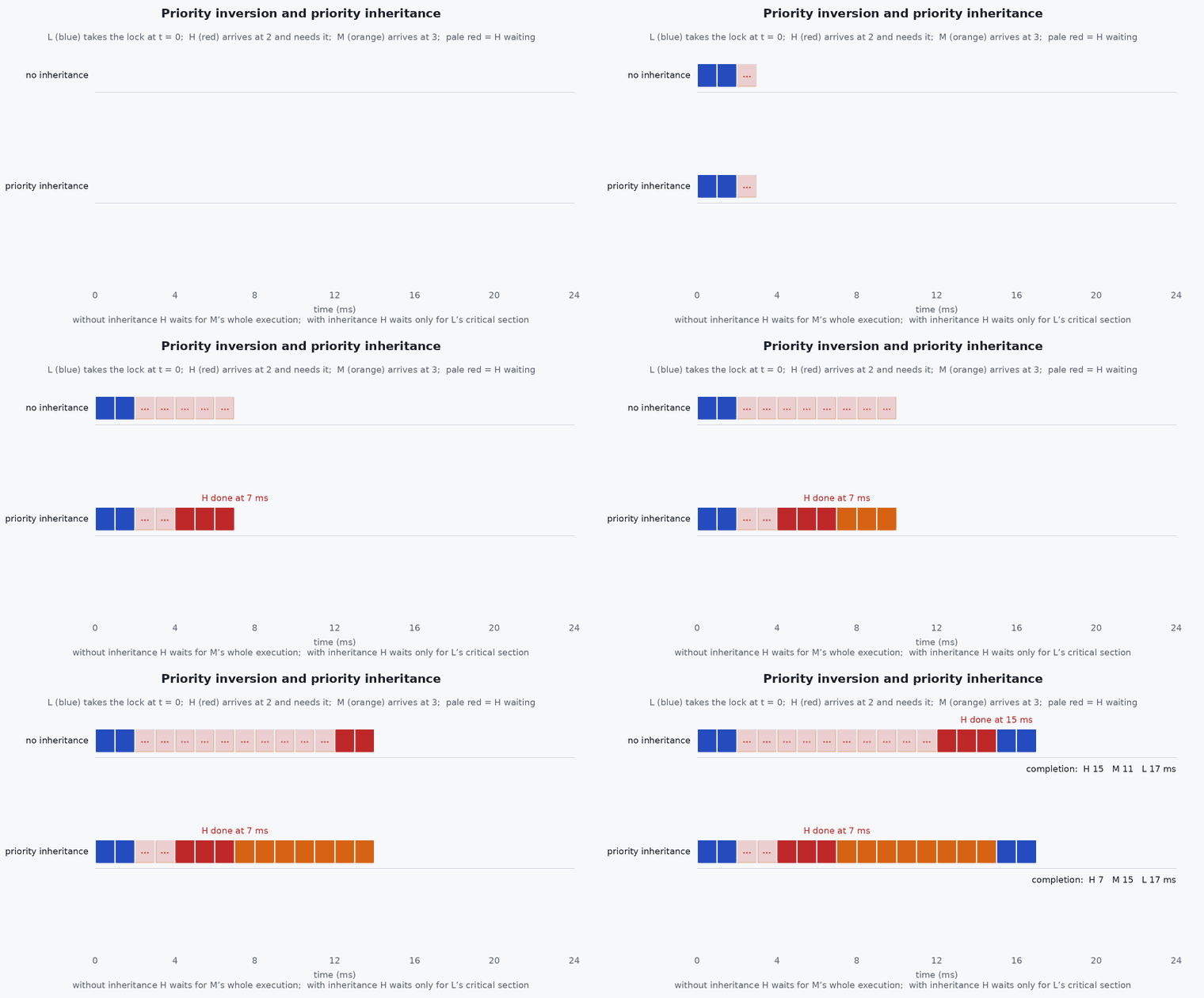
Imagine a small office where the phone (highest priority) interrupts a report (lower priority), and the report-writer occasionally holds the only photocopier that the phone-answerer also needs. If the phone-answerer waits for the copier while a medium-priority errand runs, the urgent job is delayed by an unrelated one: priority inversion. Priority inheritance fixes it by temporarily raising the copier holder’s priority so it finishes quickly.
The key mental shift is from average to worst case. The average execution time of the EKF is irrelevant; its worst-case execution time and the worst-case interference from higher-priority tasks decide whether its deadline holds.
Mathematical formulation
For fixed-priority preemptive tasks with execution time , period (deadline ), blocking , tasks indexed by decreasing priority, the worst-case response time is the smallest fixed point of
Iterate from until it converges or exceeds . For rate-monotonic priorities (shorter period, higher priority) and implicit deadlines the Liu-Layland sufficient bound is . Priority inheritance bounds blocking to the length of one critical section of each lower-priority task per resource instead of unbounded blocking by medium-priority tasks. Jitter of a periodic task’s start, , enters the control design as extra delay.
- , ,
- worst-case execution time, period, deadline.
- worst-case blocking from lower-priority tasks.
- worst-case response time.
Architecture and data flow
Sensor interrupt (IMU data ready) → driver task (high priority) → estimator task → controller tasks → output driver. Lower-priority tasks: navigator, commander, MAVLink, logger. In PX4, modules run on work queues with defined priorities (rate controllers on the highest, logging and communication lower). Shared data goes through uORB, which is designed to avoid long blocking; any additional shared resource you add (a mutex in a custom module) becomes a candidate source of priority inversion.
Real-world UAV applications
- Choosing priorities and periods for custom flight-controller modules.
- Setting up a PREEMPT_RT or isolated-core configuration on a companion.
- Explaining jitter in a flight log.
- Writing the timing section of a safety case.
Implementation example
This runs as shown. Response-time analysis for a PX4-like task set (illustrative periods and worst-case execution times, not PX4’s actual values), with a blocking term to show priority inversion’s effect, and a check against a brute-force preemptive schedule simulation.
import math, numpy as np
tasks = [  # (name, period s, WCET s) rate-monotonic order: shortest period first. Illustrative values.
    ('rate ctrl', 0.004, 0.0006), ('attitude', 0.008, 0.0010), ('ekf', 0.010, 0.0025), ('navigator', 0.050, 0.0060), ('logger', 0.100, 0.0150)]
def response_times(tasks, blocking=None):
    R = []
    for i, (n, T, C) in enumerate(tasks):
        B = (blocking or {}).get(n, 0.0); r = C + B
        while True:
            r_new = C + B + sum(math.ceil(r / tasks[j][1]) * tasks[j][2] for j in range(i))
            if abs(r_new - r) < 1e-12 or r_new > T: r = r_new; break
            r = r_new
        R.append(r)
    return R
R = response_times(tasks); Rb = response_times(tasks, {'attitude': 0.0030})            # attitude blocked 3 ms by a lower-priority critical section
for (n, T, C), r, rb in zip(tasks, R, Rb): print(f"{n:>9}: T {T * 1e3:5.0f} ms  C {C * 1e3:5.2f} ms  R {r * 1e3:6.2f} ms  R with blocking {rb * 1e3:6.2f} ms  {'OK' if rb <= T else 'MISS'}")
# brute-force check by simulating preemptive fixed-priority scheduling in 10 us ticks
dt = 1e-5; H = 0.2; remaining = [0.0] * len(tasks); rel = [0.0] * len(tasks); worst = [0.0] * len(tasks)
for k in range(int(H / dt)):
    t = k * dt
    for i, (n, T, C) in enumerate(tasks):
        if abs((t / T) - round(t / T)) < dt / T / 2 and t > 0 or k == 0: remaining[i] += C; rel[i] = t
    for i in range(len(tasks)):
        if remaining[i] > 1e-12:
            remaining[i] -= dt
            if remaining[i] <= 1e-12: worst[i] = max(worst[i], t + dt - rel[i])
            break
print("simulated worst response (ms):", [round(w * 1e3, 2) for w in worst])
assert all(w <= r + 2e-4 for w, r in zip(worst, R)) and R[2] < tasks[2][1] and Rb[1] > R[1]Common engineering mistakes
Equating real-time with fast
It is about bounded worst-case timing.
Using average execution times
Use measured worst case under load, with margin.
Unprotected shared resources
Priority inversion; use inheritance and short critical sections.
Too many high-priority tasks
The priority scheme collapses when everything is urgent.
Assuming a real-time kernel is real-time without measurement
Measure worst-case latency on your hardware under load (cyclictest).
Failure modes
| Failure mode | How it shows up | Likely cause |
|---|---|---|
| Occasional control-loop overrun | Rare glitches in attitude | Worst-case path or blocking longer than analysed |
| Priority inversion | High-priority task stalls | Mutex held by a low-priority task, medium task preempting it |
| Starvation of low-priority tasks | Logger or telemetry stops | Utilisation by high-priority tasks too high |
| Jitter in sensor timestamps | Noisy dt | Timestamping after the scheduling delay instead of at the interrupt |
Debugging approach
- Measure per-task execution time distributions and the worst case.
- Trace scheduling events to find preemption and blocking.
- Check for mutexes shared across priorities.
- Timestamp at the interrupt, not in the task.
Practical exercises
- Compute for each task in your own module set and compare with the measured values.
- Add a task with a 20 ms period and 4 ms WCET and find which deadlines then fail.
- Run cyclictest on your companion with and without load and report the maximum latency.
- Explain priority inversion with a timeline for three tasks.
Interview questions
Write an answer in your own words, then reveal the model answer. Nothing is sent anywhere.
Question 1
What is the difference between hard and soft real-time?
Model answer
In hard real-time a missed deadline is a failure (an attitude control loop); in soft real-time it degrades quality (a late video frame).
Question 2
What is priority inversion and how is it avoided?
Model answer
A high-priority task waits for a resource held by a low-priority task that a medium-priority task preempts; priority inheritance temporarily raises the holder’s priority so that blocking is bounded.
Question 3
How do you show a task set is schedulable?
Model answer
Use utilisation bounds as a quick sufficient test, and response-time analysis with measured worst-case execution times and blocking for a definitive answer on fixed-priority systems.
References and further reading
Primary papers, official documentation and standards. Each claim above that is specific to a tool or version points here.
- Liu, C. L. & Layland, J. W. (1973). Scheduling algorithms for multiprogramming in a hard-real-time environment. J. ACM 20(1)
- Sha, L., Rajkumar, R. & Lehoczky, J. P. (1990). Priority inheritance protocols: an approach to real-time synchronization. IEEE Trans. Computers 39(9)
- Apache NuttX documentation
- Linux Foundation: Real-Time Linux (PREEMPT_RT)