UAV Systems Engineering · Module 8
M8-T17: System acceptance criteria
Acceptance is a decision made by applying a rule written in advance to evidence collected on a frozen baseline.
The end of a development phase is a decision: accept the system, reject it, or accept with limitations. To be credible the decision must follow a rule that was agreed before the data existed. This lesson covers the form of such a rule, how to apply it, and how to handle the marginal and failing cases honestly.
Learning objectives
After this lesson, you should be able to:
- Write acceptance criteria with metric, threshold, statistic, sample size and conditions.
- Apply criteria to recorded results and produce an accept, reject or conditional verdict.
- Handle waivers and deviations with a recorded rationale and authority.
- Freeze the baseline and protect the criteria from retrospective changes.
Conceptual explanation
Established Acceptance practice is standard in systems engineering and contracting. The example thresholds are illustrative and do not describe any real specification.
An acceptance criterion states:
- What is measured and how (the metric, the reference, the sampling).
- The threshold and the statistic (for instance 95th percentile of horizontal error over each 5-minute segment ≤ 2.0 m).
- Conditions of the test (environment, speed, duration, configuration).
- Sample size and the confidence the claim carries (see the requirements and V&V lessons).
- The decision rule including how invalid tests, outliers and failures are treated: for example no discarding of failed runs, invalid runs rerun, all criteria must pass.
The baseline (software, parameters, calibration, hardware) is frozen for the acceptance tests; a change after the tests invalidates the results of affected criteria. Results outside the criterion are not “massaged”: they lead to rejection, rework, or a waiver (a documented acceptance of a deviation with rationale, conditions and the authority’s signature, and a corresponding operational limitation).
Engineering intuition
Think of a driving test: the examiner does not decide halfway through whether the speed limit is 50 or 60. The rule is public, the test is repeatable, and the examiner applies it. If you pass on a lucky day and fail the next, the rule needs more repetitions, not different thresholds. Acceptance for a UAV navigation system is the same, with extra care because the sample is small and the consequences are physical.
Marginal results are where integrity matters. A system that meets the 95th-percentile criterion in 44 of 45 runs may or may not pass depending on the rule written in advance. If the rule said zero exceedances, it fails, and the honest responses are to fix and retest, or to document a limitation, not to reinterpret the rule.
Mathematical formulation
A pass/fail acceptance on a success probability uses the one-sided binomial test written in advance: accept if the number of failures in independent runs is at most where is the largest integer such that the exact probability of observing failures when the true failure rate equals the unacceptable rate is below the consumer’s risk :
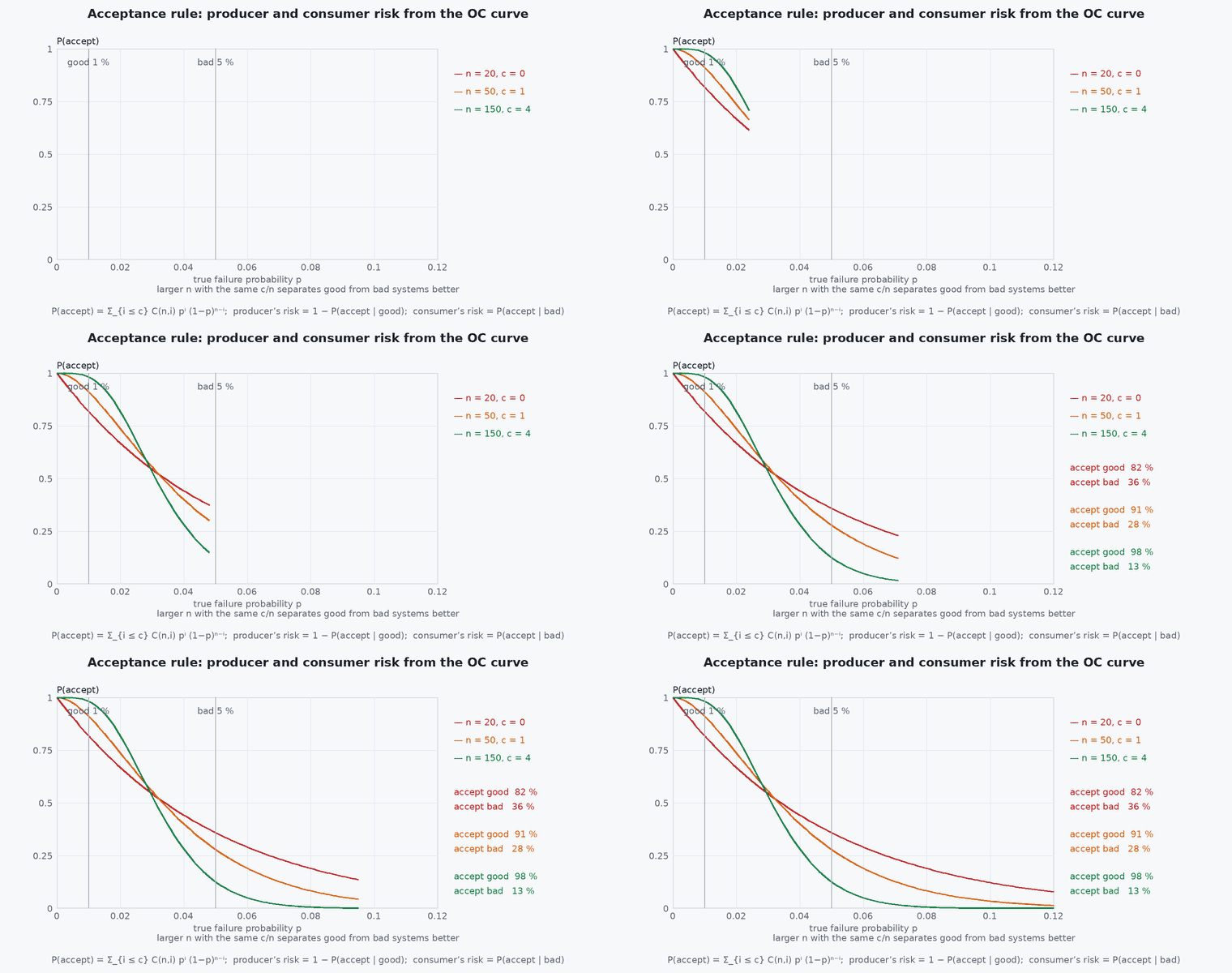
For and with the plan is (probability of 22 straight successes at is ). The producer’s risk (rejecting a good system) is the probability of exceeding when the true failure rate is the acceptable one, ; with zero allowed failures and over 22 runs it is %, which shows why strict plans need either a better system or a larger with . The operating characteristic of a plan (the accept probability against the true failure rate) should be computed and shown with the criterion.
- ,
- number of runs and maximum allowed failures.
- ,
- unacceptable and acceptable failure rates.
- consumer’s risk (accepting a bad system).
Architecture and data flow
Requirements and criteria file (frozen, signed) → test results (with baseline ID and manifest) → acceptance evaluator script (reads criteria and results, applies the decision rule, lists invalid and missing tests) → acceptance report (pass, fail, waived, with evidence links) → review board decision, waivers recorded with authority and conditions → operational limitations document (next lesson). Any change to the baseline or criteria after the freeze triggers re-evaluation of the affected criteria.
Real-world UAV applications
- Final acceptance of a GNSS-denied navigation capability.
- Supplier acceptance tests for a sensor or a payload.
- Gate reviews between test phases.
- Documenting why a deviation was accepted and under which limits.
Implementation example
This runs as shown. An acceptance evaluator: criteria with metric, threshold, statistic and plan; results with baselines; verdicts including invalid and stale results; and the sampling-plan arithmetic with its operating characteristic. The criteria and results are illustrative.
import math
from math import comb
def cdf(x, n, p): return sum(comb(n, i) * p ** i * (1 - p) ** (n - i) for i in range(x + 1))
def plan(n, p_bad, beta):
    # largest x_max with P(X <= x_max | p_bad) <= beta, or -1 if even zero failures is too probable (n too small)
    best = -1
    for x in range(n + 1):
        if cdf(x, n, p_bad) <= beta: best = x
        else: break
    return best
print("plan n = 22, p_bad = 0.10, beta = 0.10 -> x_max =", plan(22, 0.10, 0.10), "; producer risk at p_good = 0.02:", round(1 - cdf(plan(22, 0.10, 0.10), 22, 0.02), 2))
assert plan(22, 0.10, 0.10) == 0 and plan(21, 0.10, 0.10) == -1 and abs(1 - cdf(0, 22, 0.02) - 0.36) < 0.01
for n_runs in (22, 45, 80):                                                          # operating characteristic with the plan that fits n at beta = 0.10
    x = plan(n_runs, 0.10, 0.10); print(f"n = {n_runs}: x_max = {x}; P(accept) at true failure rate 0.02: {cdf(x, n_runs, 0.02):.2f}, 0.05: {cdf(x, n_runs, 0.05):.2f}, 0.10: {cdf(x, n_runs, 0.10):.2f}")

BASELINE = 'v1.4'
criteria = [dict(id='AC-1', req='R-10', text='p95 horizontal error <= 2.0 m, GNSS-denied 5 min', n_min=45, max_exceed=0),
            dict(id='AC-2', req='R-11', text='VO loss detected <= 0.5 s and safe action started', n_min=22, max_exceed=0),
            dict(id='AC-3', req='R-12', text='odometry latency p99 <= 100 ms', n_min=1, max_exceed=0)]
results = {'AC-1': dict(n=45, exceed=0, baseline='v1.4', invalid=0), 'AC-2': dict(n=22, exceed=1, baseline='v1.4', invalid=2), 'AC-3': dict(n=1, exceed=0, baseline='v1.3', invalid=0)}
def evaluate(criteria, results):
    verdicts = {}
    for c in criteria:
        r = results.get(c['id'])
        if r is None: verdicts[c['id']] = 'NOT RUN'
        elif r['baseline'] != BASELINE: verdicts[c['id']] = f"STALE (baseline {r['baseline']}, frozen {BASELINE})"
        elif r['n'] < c['n_min']: verdicts[c['id']] = f"INCOMPLETE ({r['n']} of {c['n_min']} runs)"
        elif r['exceed'] > c['max_exceed']: verdicts[c['id']] = f"FAIL ({r['exceed']} exceedance(s))" + (f", {r['invalid']} invalid run(s) must be rerun, not dropped" if r['invalid'] else '')
        else: verdicts[c['id']] = 'PASS'
    return verdicts
v = evaluate(criteria, results)
for k, s in v.items(): print(k, s)
decision = 'ACCEPT' if all(s == 'PASS' for s in v.values()) else 'REJECT or conditional acceptance with waivers'
print("decision:", decision)
assert v['AC-1'] == 'PASS' and v['AC-2'].startswith('FAIL') and v['AC-3'].startswith('STALE') and decision.startswith('REJECT')Common engineering mistakes
Changing criteria after seeing the data
The decision rule must be fixed first.
Dropping failed runs as “outliers”
Report every run; reruns are for invalid tests only, with the reason recorded.
Accepting on a changed baseline
Results belong to the baseline they were measured on; re-test after changes that could matter.
Pass/fail without an operating characteristic
Show the risks of wrong decisions: how likely a good system is to fail and a bad one to pass.
Informal waivers
Record rationale, conditions, authority and the resulting limitation.
Failure modes
| Failure mode | How it shows up | Likely cause |
|---|---|---|
| Dispute about the verdict | Parties disagree on a borderline case | Rule or statistic not defined in advance |
| Accepted a system that later fails in the field | Escape of a defect | Sample too small or conditions not representative |
| Rejected a good system repeatedly | High producer risk | Plan too strict for the sample size |
| Unnoticed baseline change | Evidence does not match the delivered system | No baseline ID or freeze |
Debugging approach
- Check each result’s baseline ID against the frozen baseline.
- Compute the operating characteristic of each plan.
- List invalid and missing tests with reasons.
- Review waivers for completeness: rationale, conditions, authority, limitation.
Practical exercises
- Design a plan for and : how many runs for ?
- Compute the producer risk for and at .
- Write acceptance criteria for the detection-time requirement with statistics.
- Draft a waiver for a requirement that passed in daylight tests only.
Interview questions
Write an answer in your own words, then reveal the model answer. Nothing is sent anywhere.
Question 1
Why must acceptance criteria be fixed before testing?
Model answer
To prevent hindsight bias and disputes: a rule chosen after seeing the data can be tuned to pass, whereas a rule agreed in advance can be applied by anyone to the same evidence.
Question 2
What is the difference between producer’s and consumer’s risk?
Model answer
Consumer’s risk is the probability of accepting a system that is actually unacceptable; producer’s risk is the probability of rejecting one that is actually acceptable. A sampling plan trades them off through and the allowed failures.
Question 3
How should a waiver be handled?
Model answer
As a recorded decision by the accountable authority, with rationale, the conditions under which it holds, and a matching operational limitation.
References and further reading
Primary papers, official documentation and standards. Each claim above that is specific to a tool or version points here.
- NASA Systems Engineering Handbook (NASA/SP-2007-6105), product validation and acceptance
- Clopper, C. J. & Pearson, E. S. (1934). The use of confidence or fiducial limits illustrated in the case of the binomial. Biometrika 26(4)
- NIST/SEMATECH e-Handbook of Statistical Methods: Lot acceptance (acceptance sampling)