UAV Systems Engineering · Module 4
M4-T15: Localization failure detection
A localiser that fails silently is worse than none: monitor its own evidence and an independent source, and publish a confidence, not just a pose.
Every localiser has conditions under which it is confidently wrong. The defence is a monitor built from three kinds of evidence: how well the data fit the model, whether the filter’s statistics are consistent, and whether an independent sensor agrees.
Learning objectives
After this lesson, you should be able to:
- List the evidence of localisation health: fit residual, inlier ratio, covariance and innovation statistics, cross-checks.
- Build a monitor with thresholds and hysteresis and measure its detection delay and false alarms.
- Explain why confidence must accompany the pose.
- Connect the monitor to the navigation manager and failsafe design.
Conceptual explanation
Three families of evidence: fit quality (registration residual, inlier ratio, number of matched features or points, particle-filter effective sample size and likelihood); statistical consistency (NIS and NEES-style tests, covariance growth; lessons M3-T13, M3-T14); and independent cross-checks (odometry versus map-based pose jumps, a barometer or GNSS where available; lesson M2-T6). The monitor outputs a confidence level (lesson M2-T16), not only a binary flag.
Engineering intuition
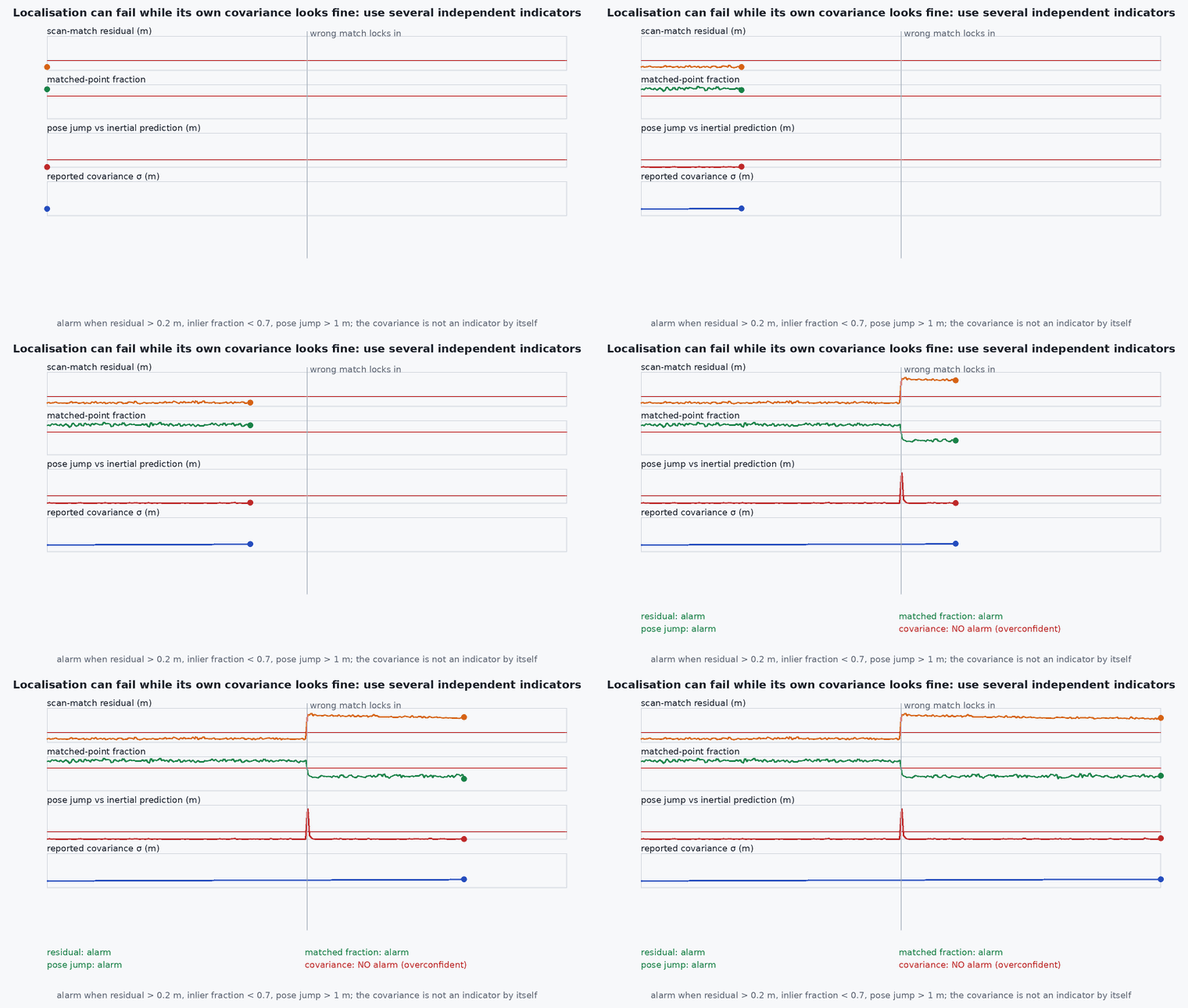
A localiser fails in two ways: it loses (no match: the evidence disappears and is easy to see) or it locks onto the wrong place (a good match to the wrong map region: the fit is fine and only independent evidence reveals it). A pose that suddenly jumps relative to the odometry by more than the odometry could have drifted is the classic signature of the second. The monitor must therefore compare the localiser with something else.
Mathematical formulation
A simple consistency check between the map-based pose and the odometry-propagated pose , with respective covariances:
Detection design: a sliding-window score (fraction of inlier points) with enter threshold and a lower exit threshold ; hold time before returning to healthy. Report the detection delay after a failure and the false-alarm rate on healthy data (lesson M3-T14).
- ,
- covariance of each pose estimate.
- squared Mahalanobis distance between the two poses.
Architecture and data flow
Localiser publishes pose, covariance and diagnostics (inlier ratio, residual, ) → monitor → confidence → navigation manager (modes, lesson M2-T16; degraded behaviour, lesson M8-T10). On failure the manager switches the controller’s position source to odometry only, freezes map-based corrections, and starts a relocalisation procedure (hover, spin, search) or a failsafe timer.
Real-world UAV applications
- Safe use of a prior map in GNSS-denied flight.
- Triggering relocalisation after a layout change.
- Feeding the failsafe design in module 8.
- Logging localisation health for post-flight analysis.
Implementation example
This runs as shown: a simulated flight where the localiser is right until and then locks onto a wrong place (a 6 m jump) with a good fit. The fit-only monitor misses it; the odometry cross-check detects it within a second; hysteresis avoids chatter.
import numpy as np
rng = np.random.default_rng(1)
dt, n, fail_at = 0.1, 600, 300
t = np.arange(n) * dt; truth = np.stack([3.0 * t, 0 * t], axis=1)
odo = np.zeros((n, 2)); drift = np.cumsum(0.003 * rng.standard_normal((n, 2)), axis=0)            # slow odometry error (std 0.03 m per sqrt(s) here)
odo = truth + drift
loc = truth + 0.05 * rng.standard_normal((n, 2)); loc[fail_at:] += np.array([6.0, 2.0])         # the localiser locks onto the wrong place at t = 30 s
inlier = 0.85 + 0.03 * rng.standard_normal(n)                                                       # fit quality stays good after the failure

P_map, P_odo = np.eye(2) * 0.05 ** 2, np.eye(2) * 0.4 ** 2                                         # reported covariances (odometry allowed a little drift)
chi2_999 = 13.82                                                                                    # chi-square(2) 99.9%

def monitor(use_crosscheck, hold=3.0):
    healthy, good_since, status, first_alarm, false_alarm = True, None, [], None, 0
    for k in range(n):
        d = loc[k] - odo[k]; d2 = d @ np.linalg.inv(P_map + P_odo) @ d
        bad = inlier[k] < 0.5 or (use_crosscheck and d2 > chi2_999)
        if bad:
            healthy, good_since = False, None
            if first_alarm is None and k >= fail_at: first_alarm = k
            if k < fail_at: false_alarm += 1
        elif not healthy:
            good_since = t[k] if good_since is None else good_since
            if t[k] - good_since >= hold: healthy = True
        status.append(healthy)
    return first_alarm, false_alarm, status

a_fit, fa_fit, _ = monitor(False); a_x, fa_x, st = monitor(True)
print(f"fit-only monitor: first alarm {a_fit}; with the odometry cross-check: first alarm at step {a_x} (failure at {fail_at}), false alarms before the failure: {fa_x}")
assert a_fit is None                                                                              # a good fit to the wrong place is invisible to the fit evidence
assert a_x is not None and a_x - fail_at <= 10 and fa_x == 0 and not any(st[a_x:]) # detected within 1 s, no false alarms, stays unhealthy (hysteresis)Common engineering mistakes
Monitoring fit quality only
A confident wrong match has a good fit.
No independent reference
Without it, a consistent wrong answer cannot be detected.
Binary healthy flag
The manager needs graded confidence and a reason.
No hysteresis
The status chatters around thresholds.
Ignoring the cost of false alarms
Needless failsafes also endanger the mission: measure the false-alarm rate on healthy data.
Failure modes
| Failure mode | How it shows up | Likely cause |
|---|---|---|
| Silent wrong lock | Confident wrong pose | Aliasing with a good fit |
| Late detection | Error exceeds clearance before the alarm | Window too long or threshold too loose |
| False alarms | Needless mode changes | Thresholds from nominal data only |
| Stuck in failed state | Never recovers | Hold condition unreachable |
Debugging approach
- Replay logs with injected pose jumps and measure detection delay.
- Plot and inlier ratio against time.
- Measure false alarms over hours of healthy data.
- Check that the manager reacts to every status transition.
Practical exercises
- Choose thresholds for 1 false alarm per 100 flight hours given your distribution.
- Add a barometer cross-check for altitude jumps.
- Design the relocalisation procedure for a UAV that loses its map-based pose.
- Write the log fields needed to investigate a localisation failure afterwards.
Interview questions
Write an answer in your own words, then reveal the model answer. Nothing is sent anywhere.
Question 1
Why is fit quality not enough to detect localisation failure?
Model answer
A localiser that locks onto the wrong place can have an excellent fit; only independent evidence such as odometry, another sensor or consistency over time reveals it.
Question 2
What does the cross-check compare?
Model answer
The map-based pose against an independently propagated odometry pose, using their covariances, with a chi-square threshold.
Question 3
Why publish a confidence rather than a flag?
Model answer
The manager chooses graded responses (continue, slow down, hold, land) depending on how bad and why.
References and further reading
Primary papers, official documentation and standards. Each claim above that is specific to a tool or version points here.
- PX4: innovation and consistency checks in EKF2
- . Bar-Shalom, . . Li, . Kirubarajan, Estimation with Applications to Tracking and Navigation, Wiley, 2001, chapter 5.
- C. Cadena et al., Past, present, and future of SLAM (arXiv:1606.05830)